Our Short List of 3

- Amazon US: https://www.amazon.com/dp/B0DZNNRBMS

- Amazon US: https://www.amazon.com/dp/B0FCRL3X1Y
- Amazon US: https://www.amazon.com/dp/B0CFKZH5FJ
All 3 Picks at a Glance
| Product | Specs | Action |
|---|---|---|
| 1. Blackview BV6200 Plus — the Big-Battery, Loud-Speaker Option |
| Check price on Amazon |
| 2. Ulefone Armor X16 — Large Battery and a Night-Vision Camera |
| Check price on Amazon |
| 3. Ulefone Armor X12 — the Compact Rugged Option |
| Check price on Amazon |
Key takeaways
- Compare rugged no contract smartphones that are unlocked and page-rated for water, dust and drops, with battery, screen and camera specs for work and travel.
As an Amazon Associate we earn from qualifying purchases.
A rugged no contract smartphone has to satisfy two separate demands at once. The first is physical: the phone must be built to survive water, dust, drops and rough handling that would end an ordinary handset. The second is commercial, and it is just as important: the phone must be sold unlocked, with no carrier contract tying you to one network, so you can insert your own SIM, change networks when you move or travel, and keep the same handset throughout. Plenty of phones meet one of those demands without meeting the other. Contract handsets can be rugged but locked, and plenty of unlocked phones are fragile glass slabs. This guide only keeps models whose Amazon US product page states both sides of the equation in its own wording: a rugged smartphone, sold unlocked.
That strict reading shapes the shortlist below. Every pick is titled as a rugged smartphone and as unlocked on its product page, and every specification quoted here — ingress ratings, battery capacity, screen size, memory, cameras and network notes — comes from that page. Where a page limits carrier compatibility, that limit is stated plainly, because an unlocked phone is only useful on a network it actually supports. Read the carrier notes for each model before you choose, especially if you plan to use the phone on a CDMA-based network, because several rugged models are GSM-only designs.
Disclosure: This article contains affiliate links. If you buy through these links, we may earn a commission at no additional cost to you.
How to Choose a Rugged No Contract Smartphone
Start with the rating, not the marketing word. The word rugged on its own tells you very little. Look for the specific standards the page states. An IP68 rating describes sealing against dust and immersion in water, IP69K adds resistance to close-range, high-pressure water, and a MIL-STD-810-series listing describes a phone built and assessed against military-style environmental stresses such as drops, vibration and temperature extremes. Two of the phones below state IP68 and IP69K figures and a military standard on their pages, with the exact revision differing between models, while the third is titled as a rugged smartphone on its page and carries its protection story in that rugged design and build. Compare the revision and the stated drop and immersion figures rather than assuming every rugged badge means the same thing.
Confirm what unlocked means for your network. Unlocked means the handset is not tied to a carrier contract and accepts a SIM from a compatible network. It does not mean the phone works on every network. Rugged phones from specialist brands are often built around GSM networks and specific LTE bands, and their pages say so. One phone below supports T-Mobile and MetroPCS on GSM and is explicitly not compatible with several CDMA carriers. Another lists T-Mobile as its wireless carrier in its specification table. Check the band list on the page against your carrier before ordering, and treat that check as part of the purchase, not an afterthought.
Match battery size to how you actually work. Rugged phones carry some of the largest batteries in the smartphone market, because their buyers work outdoors, travel between sites, or spend days away from a charger. The capacities below range from a compact 4,860 mAh cell in the smallest phone to 11,000 mAh in the largest. A bigger battery means longer intervals between charges, and on one model it also means OTG reverse charging, so the phone can top up another device. The trade-off is size and weight: the big-battery phones are thick, heavy tools, while the compact model is closer to an ordinary handset in the hand.
Think about the screen and the conditions around it. Outdoor work means glare, gloves, rain and one-handed use. The pages below state screen sizes from 5.45 inches to 6.56 inches and refresh rates from 60 Hz to 90 Hz, and one model states a brightness figure intended to keep the display readable in sunlight. A smaller screen is easier to use with gloves and easier to pocket in work clothing. A larger screen is better for maps, documents, photos and video calls from a site cabin. Neither is automatically better; the right answer depends on whether the phone lives in a pocket or on a dashboard mount.
Check the extras that matter on a job. Specialist rugged phones add tools that mainstream handsets leave out: very loud speakers that can be heard over machinery, underwater camera modes, night-vision cameras, glove-friendly touch, headphone jacks, FM radio that works without a headset, and software toolboxes with compasses and barometers. These details sound minor in a specification table and become decisive in daily use, so the product sections below call them out model by model.
1. Blackview BV6200 Plus — the Big-Battery, Loud-Speaker Option
- Amazon US: https://www.amazon.com/dp/B0DZNNRBMS
The Blackview BV6200 Plus is the heavyweight of this shortlist in almost every sense. Its product page titles it as a rugged smartphone, unlocked, and the specification story underneath is built around endurance. The battery is an 11,000 mAh unit, and the page states that it supports OTG reverse charging, so the phone can be used to charge other devices when you are away from a socket. For multi-day hiking trips, long site shifts and travel where charging points are scarce, that combination of a very large cell and reverse charging is the core of the phone’s appeal.
The durability claims are stated in full. The page gives the BV6200 Plus an IP68 and IP69K design with MIL-STD-810H, and it quantifies the protection: survival of drops from 1.2 metres and water resistance up to 1.5 metres for 30 minutes, with a padded TPU cover and a silicone-sealed display contributing to the waterproofing. Those are page-stated figures for this configuration, and they place the phone firmly in the class of handsets built for construction sites, farms, workshops and outdoor work rather than for careful indoor use.
Performance hardware is mid-range and honestly described. The page names an octa-core T606 processor built from two A75 cores and six A55 cores at 1.6 GHz, up to 24 GB of RAM with expansion, and 256 GB of storage expandable to 2 TB with a TF card. The operating system is Android 15 with Blackview’s DokeOS 4.0 on top. The display is a 6.56-inch HD+ IPS panel with a 90 Hz refresh rate and a stated brightness of 450 cd/m², which the page presents as keeping the screen clear in sunlight. Three card slots are listed in the title, and the connectivity section states Bluetooth 5.0, dual SIM 4G and NFC for Google Pay, with face and fingerprint unlock and positioning from GPS, GLONASS, Beidou and Galileo.
Two features separate this phone from a generic rugged handset. The first is the speaker: the page describes a 3 W peak stereo speaker with a wide 34 mm amplitude and a maximum volume of up to 98 dB, aimed at being heard outdoors and in noisy workplaces. The second is the camera system, listed as a 16 MP plus 13 MP AI camera capturing 1080P video, with an underwater mode and AI editing tools named on the page. The carrier note is equally important and is stated on the page itself: the phone supports GSM networks such as T-Mobile and MetroPCS and is not compatible with CDMA carriers such as AT&T, Cricket Wireless, Verizon, Straight Talk or U.S. Cellular. Buy it for a GSM network and it fits the no-contract brief exactly; buy it for a CDMA network and it will not connect.
2. Ulefone Armor X16 — Large Battery and a Night-Vision Camera
- Amazon US: https://www.amazon.com/dp/B0FCRL3X1Y
The Ulefone Armor X16 takes a slightly different route to the same brief. Its page titles it as a rugged smartphone and an unlocked cell phone on dual SIM 4G LTE, and it pairs a 10,360 mAh battery with 33 W charging, so the large cell is not left waiting all night to refill. The page states a talk time of 56 hours for this model. Physically it measures 6.81 x 3.27 x 0.67 inches and weighs 13.9 ounces, which tells you honestly that this is a substantial handset built around its battery and its protective body rather than around slimness.
The screen is a 6.56-inch panel with a 720 x 1612 resolution and a 90 Hz refresh rate. The processor is a MediaTek Helio model running at 2 GHz, with 12 GB of RAM and 128 GB of storage, expandable to 2 TB. The operating system is Android 15. The camera array is one of the more distinctive in this class: the page lists 48 MP, 20 MP, 2 MP and 16 MP cameras, and Ulefone’s own feature list for this listing identifies the 20 MP unit as a night-vision camera alongside the 48 MP rear camera, which suits security work, site inspections after dark and outdoor use where a standard phone camera gives up. Widevine L1, NFC and GPS are all stated on the page, so streaming, contactless use and navigation are covered.
The box contents are listed in full, which matters for a work phone that may be deployed straight from the box: an AC power charger at 33 W, a SIM needle, a lanyard, a screen protector, a Type-C to Type-C data cable and user manuals. The colour of this configuration is listed as Sand Dune. As with every phone in this guide, the unlocked status stated on the page removes the contract, but it does not remove the need to check bands: confirm that the 4G LTE bands your carrier uses are among those your chosen network requires before you rely on the phone as your only handset.
3. Ulefone Armor X12 — the Compact Rugged Option
- Amazon US: https://www.amazon.com/dp/B0CFKZH5FJ
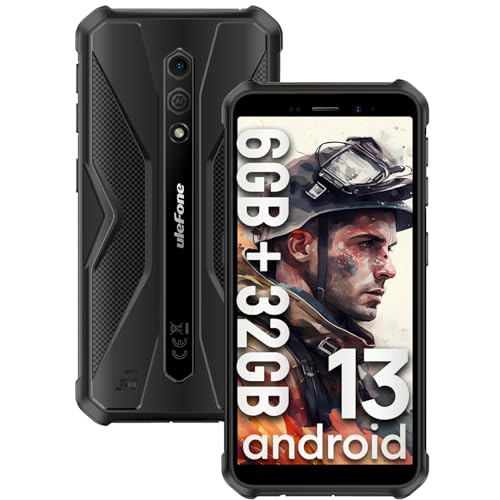
Not every buyer wants a phone the size of a small tablet, and the Ulefone Armor X12 exists for the opposite preference. Its page titles it as a rugged smartphone and as waterproof phones unlocked, and its dimensions and weight — 257 grams, with a 5.45-inch screen — make it the pocketable member of this shortlist. The display resolution is 720 x 1440 with a 60 Hz refresh rate, the operating system is Android 13 Go, and the configuration here carries 6 GB of RAM and 32 GB of storage. Those are modest figures compared with the two phones above, and the page presents them without disguise: this is a simpler, smaller, lighter rugged phone for calls, messages, navigation and everyday tasks in hard environments.
The protection figures are not modest at all. The page lists IP68 and IP69K among this model’s additional features, together with MIL-STD-810G standards, and describes the water resistance level as waterproof. In other words, the compact phone keeps the same headline ingress ratings as its larger rivals while giving up screen size, storage and battery capacity to get there. The battery is 4,860 mAh with 10 W charging, which suits a day of ordinary use rather than multi-day expeditions, and is the clearest trade-off in the design.
The detail list is practical. The page states dual SIM global 4G LTE, NFC, Bluetooth, a compass and face recognition, a 3.5 mm headphone jack, USB Type-C, headset-free FM radio and a gloves mode, plus a digital toolbox that includes a gradienter, height meter, magnifier, noise test, protractor and plumb bob among its instruments. The specification table lists T-Mobile as the wireless carrier for this model, so GSM compatibility is again the assumption to verify against your own SIM. The box contains an AC power charger, a data cable, a lanyard, a pre-installed protective film and a SIM pick. For a second phone for a worksite, a handset for a teenager working outdoors, or a backup phone that can be dropped without drama, the X12’s smaller take on the same brief is easy to understand.
Which One Should You Choose?
Choose the Blackview BV6200 Plus if battery life, speaker volume and storage headroom lead your list, and if your SIM sits on a GSM network it supports. Its 11,000 mAh battery, reverse charging, 256 GB of storage and very loud speaker make it the site-and-expedition phone of the three. Choose the Ulefone Armor X16 if you want a similarly large battery with faster stated charging and a camera set built around night vision, and you are comfortable with a big, heavy handset. Choose the Ulefone Armor X12 if size matters more than stamina: it keeps the rugged ratings and the unlocked status in a 5.45-inch body that fits ordinary pockets and gloved hands, at the cost of storage, screen and battery capacity.
Whichever model you pick, run the same final checks. Confirm the carrier bands on the product page against your network, confirm whether your work needs CDMA support that these GSM designs do not offer, decide whether you need the largest battery or the smallest body, and make sure the box contents cover the charger and cable you expect. A rugged no contract smartphone should remove two worries at once — breaking the phone, and being tied to a contract — and each of the three above is page-stated to do exactly that, in a different shape.