Key takeaways
- Compare the best home lithium battery options for backup and solar storage, with 48V LiFePO4 rack and wall-mounted picks explained by capacity, BMS, communication and safety.
As an Amazon Associate we earn from qualifying purchases.
A home lithium battery stores electricity so your house can keep running when the grid fails, or so the energy your solar panels make in the afternoon is still available after sunset. The best home lithium battery for most households today is built on lithium iron phosphate chemistry, usually called LiFePO4 or LFP, in a forty-eight volt module that connects to a hybrid or off-grid inverter. This guide explains how to choose one and compares four credible modules of exactly that type: rack-mounted and wall-mounted home storage batteries, each storing a little over five kilowatt hours per unit and designed to be combined in parallel as your needs grow.

We have deliberately kept this guide to one product type. Portable power stations, twelve volt RV batteries and starter batteries solve different problems, and mixing them into a home storage comparison only confuses the decision. Everything below is a stationary lithium battery intended to be wired into a home energy system by a qualified installer, and the specifications cited come from the manufacturers’ and sellers’ product pages rather than from any claim that we compared these units ourselves.
Why LiFePO4 Won the Home Storage Market
Three properties explain why lithium iron phosphate displaced both lead-acid and other lithium chemistries in home storage. The first is cycle life. A quality LFP module is rated for several thousand deep cycles, which translates into a decade or more of daily solar cycling, while a lead-acid bank asked to do the same job would need replacement several times over. The second is safety. LFP chemistry is inherently more thermally stable than the nickel-based lithium cells used in phones and cars, which is exactly the property you want in a large battery installed in a garage or utility room. The third is usable capacity. An LFP battery can be discharged deeply, routinely using most of its stored energy, where lead-acid must be kept near half charge to survive, so a smaller lithium bank often replaces a much larger lead-acid one.
The standard building block is a nominal forty-eight volt module — actually a little over fifty-one volts in LFP form — holding one hundred amp hours, which works out to roughly five kilowatt hours of storage. That is enough to run essential loads such as refrigeration, lighting, internet equipment and a furnace fan for hours, and modules are designed to be paralleled, so a household wanting whole-home backup simply adds more units to the same inverter.
What to Check Before You Buy
Inverter communication. The single most valuable feature in a modern home battery is closed-loop communication with the inverter, usually over CAN or RS485 cabling. When the battery’s management system talks directly to the inverter, charging follows the battery’s own measurements of temperature, voltage and state of charge, which is safer and more accurate than generic voltage-based charging. Check that your inverter brand appears on the battery maker’s compatibility list.
The battery management system. Every module below includes a one hundred amp BMS, which sets the maximum charge and discharge current and therefore the power a single module can deliver. One module can support a moderate inverter on its own, but high-power whole-home systems need several modules in parallel so their combined current rating matches the inverter.
Certifications. For a permanent home installation, look for recognised safety listings such as UL 1973 for the battery and UL 9540A test data for fire behaviour, and check what your local inspector and insurer require. Some modules below carry these listings and some do not state them, and that difference is a legitimate deciding factor.
Expansion and monitoring. Confirm the maximum number of modules that can be paralleled, and look for Bluetooth or display monitoring so you can see state of charge and cell health without additional hardware. Weight matters too: these modules are heavy, and rack or wall mounting should be planned with two people and proper hardware.
The Picks
1. ECO-WORTHY Cubix 100 48V 100Ah Server Rack LiFePO4 Battery: The Certified All-Rounder
ASIN: B0DP4LTRMG (evidence level: CANDIDATE — indexed Amazon US listing; the live product page could not be re-read at the time of writing, so confirm availability before purchase)
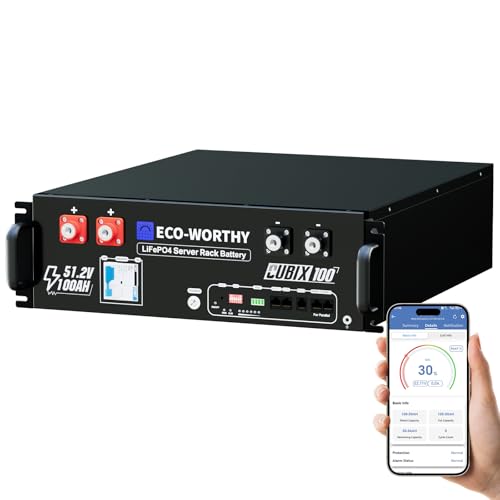
The ECO-WORTHY Cubix 100 is a server rack LiFePO4 module storing about five kilowatt hours, and its distinguishing strength is paperwork: the listing states UL 1973 and UL 9540A listings and a CEC listing, which makes conversations with inspectors and insurers considerably easier than with uncertified alternatives. For a permanent, permitted home installation, that certification set is a genuine feature, not a footnote.
The hardware matches the brief. A one hundred amp BMS manages the pack, Bluetooth monitoring lets you check the battery from your phone, and CAN and RS485 communication ports support closed-loop operation with common solar inverters. The rack format slides into a standard cabinet, and modules can be stacked in parallel to grow a system from a single essential-loads battery into a large whole-home bank. Low-temperature resistant cells in the newer Pro variant address the one weakness of LFP chemistry, its reluctance to charge in freezing conditions, which matters for unheated garages.
Choose the Cubix 100 if you want the most straightforward path through permitting and inspection, with modern monitoring and communication included.
2. EconomiPower 51.2V 100Ah Server Rack LiFePO4 Battery: The Straightforward Value Rack Unit
ASIN: B0DWXDC62M (evidence level: CANDIDATE — the Amazon US product page was read through an indexed copy confirming the product and specifications, but it showed no featured offer, so confirm availability before purchase)
The EconomiPower module is a three-unit-high rack battery with the same core specification as the class standard: a little over fifty-one volts, one hundred amp hours and roughly five kilowatt hours of storage, managed by a one hundred amp PACE BMS. Its product page describes more than six thousand cycles at deep discharge and a metal enclosure, and it supports paralleling up to fifteen modules, which is enough expansion headroom for very large home systems.
Communication is a strength here: the unit provides CAN, dual RS485 and RS232 connections, giving an installer several ways to achieve closed-loop communication with a wide range of inverters, and the package includes the parallel plates, power cables and communication cables needed for a basic installation. A five year manufacturer warranty is stated in the listing. What the listing does not prominently state is a UL listing, so buyers planning a permitted installation should confirm certification requirements with their installer and local authority before choosing this unit.
Choose the EconomiPower if your installer is comfortable with the certification position and you want generous parallel expansion and flexible communication ports in a simple rack format.
3. Vatrer Power 48V 100Ah Wall-Mounted LiFePO4 Battery: The Space-Saving Wall Option
ASIN: B0CWXMNV3Y (evidence level: CANDIDATE — indexed Amazon US listing; the live product page could not be re-read at the time of writing, so confirm availability before purchase)
Not every home has room for a battery rack, and the Vatrer Power wall-mounted module answers that problem directly. It stores the same roughly five kilowatt hours in a slim wall-hung enclosure with a built-in one hundred amp BMS, an LED monitor and a touchable smart display, so the battery itself shows its state of charge and status without opening an app. The maker rates it for more than six thousand deep cycles and describes a service life of around ten years.
The wall format keeps floor space free in a garage or utility room and makes a single-module essential-loads system look tidy rather than industrial. Mounting brackets, fixings and power cables are included according to the product description, which simplifies a straightforward installation. As with the other modules, it is designed for solar and off-grid systems and can be expanded, though buyers should confirm the parallel limit and inverter communication protocol list for the exact variant they order, and check the certification documentation for their jurisdiction.
Choose the Vatrer if floor space is your constraint and you want an integrated display on the battery itself.
4. WattCycle 48V 100Ah Server Rack LiFePO4 Battery: The Modern Rack Contender
ASIN: B0GY8WH5KT (evidence level: CANDIDATE — indexed Amazon US listing; the live product page could not be re-read at the time of writing, so confirm availability before purchase)
The WattCycle forty-eight volt module is a three-unit rack battery in the same five kilowatt hour class, built around a one hundred amp BMS and rated by its maker for more than six thousand deep cycles for home energy storage and backup. Its listing highlights an active balancing feature, which works to keep the individual cells inside the pack at even charge levels; balanced cells age more evenly, which supports the long cycle life these batteries promise.
The listing also mentions quality branded cells and includes an expansion adapter cable in the package, a small but practical detail when paralleling modules. As a newer entrant, its long-term installed track record is shorter than the most established names in this category, and buyers should verify its certification documents and inverter compatibility list against their specific system design before committing, as they should with any module in this guide.
Choose the WattCycle if active balancing and a modern rack design appeal to you and your installer confirms it suits your inverter and local requirements.
How Much Storage Does a Home Actually Need?
Start from loads, not from battery marketing. List the circuits you truly need during an outage — refrigerator, lights, internet, medical devices, a well pump or furnace fan — and estimate their combined draw and the hours you want to cover. One module in this class covers essential loads for an evening and night for most households. Families wanting air conditioning, electric cooking or full-day autonomy should plan on several modules in parallel and an inverter sized to match, and solar households should size the bank so a normal day’s surplus fits without wasting generation. A qualified installer can turn your load list into a module count in one visit, and that calculation is worth far more than any rule of thumb.
Installation and Safety Notes
These are heavy, high-energy devices, and this category is not a casual do-it-yourself project. A home storage battery connects to an inverter, a critical-loads panel and often the main service equipment, work that is regulated in most jurisdictions and may require permits and inspection. Use a licensed electrician or certified solar installer, mount rack units in a proper cabinet or rack rated for the weight, hang wall units only on structure that can carry them, and keep the installation space within the temperature range the manufacturer specifies, remembering that LFP batteries should not be charged below freezing unless the model includes cell heating. Keep the manufacturer’s manual with the system, and make sure everyone in the household knows where the system disconnect is.
Frequently Asked Questions
How long will one module run my house? One five kilowatt hour module runs essential loads — refrigeration, lighting, internet and device charging — for several hours, but it will not run a whole electrified home with air conditioning and an electric range for long. Whole-home backup is a multi-module project sized by an installer.
Can I add more batteries later? Yes, that is the point of the modular forty-eight volt format. All four picks support parallel expansion, though the maximum module count differs, so confirm the limit and keep modules of the same model and similar age together in one bank.
Will these work with my existing solar inverter? Only if the inverter is a compatible forty-eight volt hybrid or off-grid model and, ideally, appears on the battery’s communication compatibility list. Grid-tied-only inverters without battery support cannot use these modules, so verify before ordering.
How long do home lithium batteries last? The modules here are rated for several thousand deep cycles, which for daily solar cycling corresponds to roughly a decade or more of service, typically outlasting the warranty period stated in each listing. Calendar ageing continues regardless of use, so buy capacity you will actually cycle.
Verdict
For most households, the ECO-WORTHY Cubix 100 is the easiest recommendation because its stated safety listings simplify a permitted installation, and it includes the communication and monitoring a modern system needs. The EconomiPower is the flexible rack alternative with generous expansion, the Vatrer Power wall-mounted unit solves the floor-space problem elegantly, and the WattCycle brings active balancing to the same rack format. Whichever you choose, confirm inverter compatibility and certification requirements with your installer first, and the battery you install should serve your home for a decade.
Affiliate Disclosure: This article contains affiliate links. If you buy through a link on this page, we may earn a commission at no additional cost to you. Product specifications are taken from manufacturer and seller product pages, and availability can change; check the listing before you buy.