Our Short List of 3
All 5 Picks at a Glance
| Product | Specs | Action |
|---|---|---|
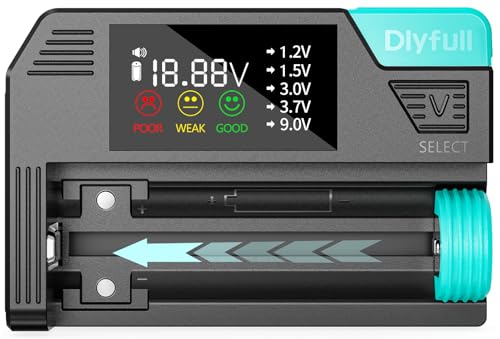 Dlyfull Universal Battery Tester | Check price on Amazon | |
 Dlyfull B2 LCD Battery Tester | Check price on Amazon | |
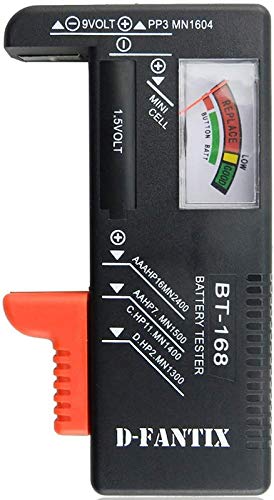 D-FantiX BT-168 Battery Tester | Check price on Amazon | |
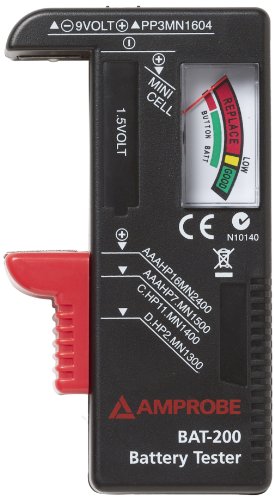 Amprobe BAT-200 Battery Tester | Check price on Amazon | |
 ZTS MBT-1 Multi-Battery Tester | Check price on Amazon |
Key takeaways
- Find the best battery testers for AA, AAA, C, D, 9V, and button cells. Compare LCD and analog checkers and pick the right tester for your home drawer.
Almost every home has a drawer full of loose batteries, and almost nobody knows which ones still hold a charge. A remote stops working, a flashlight dims on a camping trip, or a smoke alarm chirps in the middle of the night, and the usual response is to throw every battery away and buy a fresh pack. That habit wastes money and sends usable cells to recycling long before they need to go. A battery tester ends the guessing. It takes a few seconds to show whether a cell is good, weak, or ready for replacement, and it turns a jumbled drawer into a sorted supply that is ready when it is needed.
Battery testers come in two broad styles. Analog testers use a needle that swings across a color-coded scale, and they draw power from the battery being checked, so they never need a cell of their own. Digital testers use an LCD screen to show a clear good, weak, or poor reading, and some also show voltage and internal resistance. More advanced models use a pulse load to judge a battery under a brief simulated demand. This guide compares five battery testers that cover the full range of household needs, from a pocket analog checker to a pulse-load instrument that handles dozens of battery types.
As an Amazon Associate, we earn from qualifying purchases.
Quick Answer
For most households, a universal LCD tester such as the Dlyfull B2 is the best starting point because it reads AA, AAA, C, D, 9V, and button cells with a clear screen. If you want the simplest tool possible, a BT-168 analog checker needs no battery of its own. For the widest coverage, the ZTS MBT-1 tests dozens of types under pulse load.
How to Choose
Start with the battery sizes you actually own. Every tester in this guide handles AA, AAA, C, D, and 9V, but they differ once you move beyond those. If your drawers hold camera batteries such as CR123A, CR2, CRV3, 2CR5, and CR-P2, or button cells such as CR2032 and LR44, you need a tester that lists those formats by name. A tester that only accepts cylindrical cells will not help with a watch battery or a garage door remote cell, and a tester with no 9V contact will not help with a smoke alarm battery. Check the supported list before anything else.
Next, decide between an analog needle and a digital screen. An analog tester is fast to read at a glance and never needs its own battery, but the needle lands in a broad good, low, or replace zone, and two people can read the same needle slightly differently. A digital LCD tester gives a cleaner verdict with bars or words, and some models add a voltage figure. Digital testers usually need one AAA cell of their own, so keep a spare on hand and check whether that cell is included in the box.
Think about how the tester applies its load. A simple voltage check measures a battery at rest, which can make a tired cell look healthier than it really is. A tester that applies a load during the check gives a more realistic result, because a battery that holds voltage with no demand can still sag the moment a device draws current. Pulse-load testers take this further by applying a short, controlled pulse and measuring how the cell responds.
Size and storage matter as well. A tester that lives in a drawer gets used; one that lives on a high shelf does not. Pocket-size analog checkers weigh almost nothing and slip into a drawer, a glove box, or a travel kit. Larger digital units are easier to read and steadier to hold but take up more space. Some models include a cable or test leads, which help with cells that do not fit a fixed slot. Finally, remember what a battery tester cannot do: it cannot recharge a dead cell, repair a leaking battery, or tell you exactly how many minutes of life remain in a half-used cell. It sorts good from weak from dead, and that is enough to stop wasting usable batteries.
Dlyfull Universal Battery Tester
The Dlyfull Universal Battery Tester is the most capable LCD checker in this guide, and it earns its place by covering battery types that most household testers skip. Alongside AA, AAA, C, D, and 9V cells, it accepts 18650 lithium-ion cells, CR123A camera batteries, and a long list of button cells. A cable is included in the box, so cells that do not seat in a fixed slot can still be checked through the leads. The LCD screen shows a clear status reading, and the compact body fits easily in a drawer or a tool bag.
What sets this tester apart is its range. Many universal testers stop at household alkaline sizes, which leaves camera owners and flashlight users to guess about their lithium cells. This model treats those cells as first-class citizens, with dedicated support for the cylindrical lithium formats that power cameras, torches, and portable electronics. This is the tester to choose when your battery collection is mixed: if the drawer holds a little of everything, one tool can sort the whole lot.
Who Should Skip It
Skip this tester if you only ever check AA and AAA cells and want the cheapest tool available. Its wide lithium coverage is wasted on a drawer that holds nothing but alkaline cells, and a simpler analog checker will sort those just as quickly.
Dlyfull B2 LCD Battery Tester
The Dlyfull B2 is the straightforward household tester that most people should buy first. It covers AA, AAA, C, D, 9V, N, CR2, CRV3, 2CR5, CR-P2, and a wide range of button cells, which is more than enough for remotes, toys, flashlights, smoke alarms, and clocks. The LCD screen shows poor, weak, or good with clear bars, so there is no needle to interpret. One AAA cell powers the unit, and that cell is included in the box.
The B2 is built for speed. Pick up a battery, seat it in the slot, and the reading appears in a couple of seconds. The body is compact and light, measuring a little over five inches long, and the anti-slip housing makes it easy to hold with one hand while the other swaps cells. It carries an eighteen-month warranty, which is generous for a tool in this class. The design is deliberately simple: no menus, no settings, and no modes to remember. Its main limitation is that it does not test rechargeable batteries, so owners of nickel-metal hydride cells need a different tool for those.
Who Should Skip It
Skip the B2 if your battery stash is mostly rechargeable cells, because it will not test them. Skip it as well if you need to check 18650 lithium-ion cells, which fall outside its supported list.
D-FantiX BT-168 Battery Tester
The D-FantiX BT-168 is the classic pocket battery checker, and it has earned its popularity by doing one job with no fuss at all. It is a small analog tester with a sliding contact and a color-coded meter marked good, low, and replace. It handles AA, AAA, C, D, 9V, and button cells, and it needs no battery of its own because it draws its operating power from the cell being tested. There is nothing to charge, nothing to replace, and nothing to switch on.
Using it is almost automatic. Slide the red contact to fit the battery, seat the cell, and watch the needle settle. The green zone means the battery is ready to use, the yellow zone means it is fading, and the red zone means it belongs in recycling. The whole check takes a second or two, and the tester weighs so little that it can live in a drawer, a glove box, or a travel kit without being noticed. Its simplicity is also its strength in a shared household: anyone can use it without a lesson. The trade-off is precision, since the needle gives a broad verdict rather than a number, and it lacks support for lithium camera cells and larger rechargeable formats.
Who Should Skip It
Skip the BT-168 if you need readings for camera lithium cells or 18650 cells, because it does not support them. Skip it too if you want a numeric voltage reading, since the needle only gives a broad zone.
Amprobe BAT-200 Battery Tester
The Amprobe BAT-200 comes from a brand known for electrical test equipment, and it shows in the build. This is an analog tester with a color-coded scale that reads good, low, or replace, and it covers 9V, AA, AAA, C, D, and button cells. Like the BT-168, it needs no battery of its own, drawing its power from the cell under test. Its sliding contact adjusts to fit each size, and the housing is sturdy enough to survive life in a toolbox.
Where the BAT-200 stands out is its load behavior. The tester applies a load during the check, so a battery that looks fine at rest but sags under demand is more likely to be caught. The meter is large and easy to read, with clear color zones that are visible at arm’s length on a workbench. At about seven inches long, it is bigger than a pocket checker, which makes it easier to hold steady while testing. This tester suits workshops and garages. It does not test lithium camera cells, and it gives a zone reading rather than a number.
Who Should Skip It
Skip the BAT-200 if you need to test CR123A or 18650 lithium formats, which it does not cover. Skip it if you want a digital readout with a voltage figure, or if you need the smallest possible tester for travel.
ZTS MBT-1 Multi-Battery Tester
The ZTS MBT-1 is the most advanced tester in this guide, built for people whose battery collection spans many chemistries and sizes. It tests more than thirty battery types, including alkaline, nickel-metal hydride, nickel-cadmium, photo lithium, lithium-ion, and button cells. Instead of a simple voltage check, it uses a patented pulse-load method that briefly loads the cell and measures its response, which gives a more honest picture of remaining power than an open-circuit reading.
The MBT-1 runs on four AA batteries, sold separately, and it shows results on a clear display with a percentage scale. That scale makes it easy to compare cells: one near the top is strong, one in the middle is fading, and one near the bottom is done. Photographers and hobbyists will appreciate the breadth, including 3V photo lithium cells and 3.6V lithium-ion formats that other testers ignore. The cost is higher than the other testers here, and the unit is larger and heavier, so it is a bench instrument rather than a pocket tool. For a household with one drawer of AA cells, it is more tester than needed.
Who Should Skip It
Skip the MBT-1 if your needs are simple and your budget is small, because a basic LCD or analog tester will sort AA and AAA cells just as well for far less money. Casual users who test a battery once a month will not use its extra coverage enough to justify it.
Who Should Skip It
A battery tester is useful, but it is not for everyone. If you buy batteries in small quantities, use them promptly, and rarely have loose cells lying around, a tester will spend most of its life untouched in a drawer. Households that run almost entirely on built-in rechargeable batteries in phones, laptops, and tablets may also find little use for one, since there are no loose cells to sort. People who need laboratory-grade measurements should skip consumer testers altogether: these tools sort batteries into good, weak, and dead, but none measures capacity with the accuracy of a bench instrument. If you need exact capacity figures, a charger-analyzer or a multimeter with a known load is a better choice. Finally, anyone with only one battery size and a habit of replacing cells on a schedule may not need a tester at all. The tester earns its keep when the drawer is full of mixed, half-used cells or when throwing away good batteries has become a noticeable waste.
FAQ
Can a battery tester check rechargeable batteries?
Some testers can, and some cannot, so the supported list matters. The ZTS MBT-1 handles nickel-metal hydride and nickel-cadmium rechargeable cells alongside alkaline and lithium types, while the Dlyfull B2 is designed for disposable cells and does not test rechargeables.
Do analog battery testers need their own battery?
No, most analog testers draw their operating power from the battery being tested, which is why models such as the D-FantiX BT-168 and the Amprobe BAT-200 need no cell of their own. The needle moves because the cell under test supplies a small current. Digital LCD testers are different: most need one AAA cell of their own, although some include that cell in the box.
How accurate is a household battery tester?
A household tester is accurate enough to sort good cells from weak ones and dead ones, which is the job it is built for. Load-based and pulse-load testers give more honest results than simple voltage checks, because they show how a cell behaves under demand. No consumer tester gives a laboratory-grade capacity figure, so treat the reading as a sorting verdict rather than an exact measurement of remaining life.
What should I do with batteries that test as weak?
Weak batteries still hold some charge, so move them to low-demand devices such as remote controls or wall clocks, where they can finish their useful life. Keep them separate from fresh cells so they are not mixed back into the good pile. Dead batteries should go to a recycling drop-off rather than household waste, and leaking batteries should be handled with care and disposed of through a proper recycling program.
Final Verdict
The best battery tester is the one that matches the batteries you actually own. For most households, the Dlyfull B2 is the right starting point: it covers the common sizes, its LCD screen is easy to read, and it sorts a drawer in minutes. If you want the simplest tool that is always ready, the D-FantiX BT-168 needs no battery of its own. The Amprobe BAT-200 adds a trusted brand and a load-based check for workshop use, while the Dlyfull Universal tester extends coverage to lithium-ion and camera cells. For the widest coverage and the most honest readings, the ZTS MBT-1 and its pulse-load test stand alone. Buy the tester that fits your drawer, keep it where the batteries live, and use it before throwing cells away.
Product and ASIN Reference
| Product | ASIN |
|---|---|
| Dlyfull Universal Battery Tester | B0DSSYP5KB |
| Dlyfull B2 LCD Battery Tester | B07DPLD6KB |
| D-FantiX BT-168 Battery Tester | B014FEM0X6 |
| Amprobe BAT-200 Battery Tester | B005G7SBY4 |
| ZTS MBT-1 Multi-Battery Tester | B07MZBHVWC |