Key takeaways
- Chinese-brand LiPo batteries from Zeee, Ovonic, CNHL, GOLDBAT and HRB compared on cell count, capacity, C rating, connector and fit, with honest quality checks.
As an Amazon Associate we earn from qualifying purchases.
Affiliate Disclosure: This article contains affiliate links. If you buy through links on this page, we may earn a commission at no extra cost to you. We have not personally tested the batteries below; every specification is taken from the manufacturer’s Amazon US listing, and you should confirm the listing details before ordering.
Almost every affordable LiPo pack in the RC hobby is made in China, but there is a wide gap between the established Chinese hobby brands and the anonymous no-name packs that appear and disappear on marketplaces each season. Brands such as Zeee, Ovonic, CNHL (China Hobby Line), GOLDBAT and HRB have sold through Amazon US storefronts for years, publish full specifications, and answer warranty claims through identifiable seller accounts. That track record is the main reason they dominate the budget end of the market for RC cars, planes, boats and FPV drones.
This guide explains how to judge a Chinese-brand LiPo honestly, then compares five specific packs from those brands. It also covers the real risks: optimistic C ratings, capacity that falls short of the label, and cell matching that varies from batch to batch. None of the packs below were bench-tested by us, so treat the ratings printed on the labels as manufacturer claims and use the checking routine in this article when your pack arrives.
What “China LiPo” actually means in the RC hobby
China is the centre of global lithium polymer cell production, and the RC brands named here are Chinese companies that design, assemble and market their own packs. Zeee (Zeee Power) focuses on high-volume car and aircraft packs. Ovonic, sold through the Ovonic Direct storefront, targets the same hobby market with a wide range of cell counts. CNHL, short for China Hobby Line, built its reputation in FPV racing, where pilots care about voltage sag under load more than label capacity. GOLDBAT and HRB are long-running budget brands aimed mainly at RC cars, trucks and sport aircraft.
Buying from an established Chinese brand is different from buying an unbranded pack in three practical ways. First, the specifications are published in full: capacity, configuration, discharge rating, dimensions, weight and connector type. Second, the seller identity is stable, so a dead-on-arrival pack can be returned through normal Amazon channels. Third, the same model stays in production long enough for community feedback to accumulate, which makes obviously bad batches easier to spot before you buy.
None of that guarantees premium quality. It does mean you can shop with information instead of guessing, and the rest of this article is about using that information well.
How we chose these packs
Every pack below meets the same basic filters. It is a lithium polymer RC pack from a Chinese hobby brand, sold on Amazon US under that brand’s own listing. The listing states the cell count, capacity, discharge rating, dimensions and connector, so fit can be checked before ordering. The packs cover the most common use cases: 3S power for 1/10 and 1/8 scale cars and trucks, 3S sport flying, and smaller 3S packs for park flyers and FPV aircraft.
We deliberately left out unbranded packs, packs with incomplete specifications, and listings where the stated connector or dimensions were unclear. We also left out very high cell counts and specialist racing formats, because most readers searching for a Chinese-brand LiPo are equipping a car, truck, boat or sport plane rather than a competition setup.
A note on evidence: specifications in each product section come from the manufacturer’s own Amazon US listing. Listings change, sellers rotate stock, and a pack that ships this month may come from a different production batch than one shipped last year. Check the listing again at checkout and run the arrival checks described later in this guide.
The picks at a glance
| Pack | Configuration | Capacity | Discharge rating | Connector | Best for |
|---|---|---|---|---|---|
| Zeee 3S 5200mAh 80C Hard Case | 3S | 5200mAh | 80C | XT60 | 1/10 and 1/8 cars and trucks |
| Ovonic 3S 5200mAh 120C (2 packs) | 3S | 5200mAh | 120C | EC5 | High-draw car and truck setups |
| CNHL 2200mAh 3S 70C (2 packs) | 3S | 2200mAh | 70C | XT60 | Sport planes and FPV aircraft |
| GOLDBAT 3S 2200mAh 35C (2 packs) | 3S | 2200mAh | 35C | XT60 | Trainers and gentle sport flying |
| HRB 3S 5000mAh 50C | 3S | 5000mAh | 50C | Traxxas-style (TR) | Traxxas-platform trucks and cars |
1. Zeee 3S 5200mAh 80C Hard Case — the mainstream car and truck pick
ASIN: B0925W1CHX
Zeee is probably the best-known Chinese LiPo brand on Amazon US, and this 3S hard case pack is its typical formula: 5200mAh capacity, 11.1V nominal voltage in a 3S1P configuration, an 80C discharge rating, and an XT60 connector with a JST-XH balance lead. The hard case matters for surface use, because it protects the cells from stones, chassis edges and crash impacts better than a shrink-wrapped soft pack.
On paper, 5200mAh is a sensible capacity for 1/10 and 1/8 scale trucks and buggies: large enough for useful run time, small enough to fit standard battery trays. The listing gives dimensions of roughly 138 x 47 x 37 mm and a weight around 380 g for this format, but Zeee sells several 5200mAh variants with different connectors and case styles, so confirm the exact dimensions of the variant on the listing against your tray before ordering. A pack that is a few millimetres too tall is a common and avoidable disappointment.
The honest caveat is the C rating. An 80C label on a 5200mAh pack implies a very high continuous current, and like most hobby brands, Zeee’s ratings should be read as a relative guide within its own range rather than a laboratory figure. For bashing and general driving, this class of pack is widely used and generally well regarded. For sustained maximum-current racing, treat the label with scepticism and read the quality-control section below.
Best for: RC car and truck owners who want a recognised Chinese brand, a protective hard case and a common XT60 connector.
2. Ovonic 3S 5200mAh 120C (2 packs) — for high-draw setups
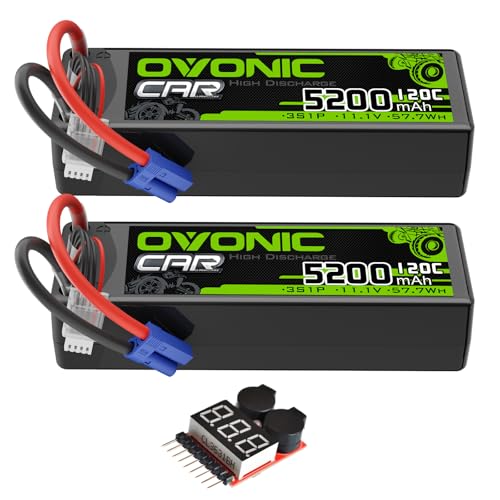
ASIN: B0D8SVQRHK
Ovonic sells this 5200mAh 3S pack as a two-pack with EC5 connectors and a bundled LiPo voltage checker, a small accessory that is genuinely useful for checking individual cell voltages at the field. The listing rates the pack at 120C, the highest figure in this roundup, and Ovonic positions it for RC cars, trucks, boats and aircraft that draw heavy current.
EC5 is a sensible connector choice at this level, since it is rated for higher current than smaller plugs and is common on 1/8 scale platforms. If your vehicle uses a different connector, budget for proper replacement plugs and solder them correctly, or choose a pack that already carries the right connector. Adapters add resistance and are a poor idea on high-current setups.
The 120C figure deserves the same caution as every headline C rating in this market segment: it is a manufacturer claim, not something we measured. What can be said fairly is that Ovonic is an established seller with a large catalogue and a long trading history, that the pack’s stated capacity and configuration suit mainstream 3S vehicles, and that buying the two-pack format suits drivers who rotate packs during a session. Check both packs on arrival with the included checker; a new pack whose cells sit far apart in voltage should go back while the return window is open.
Best for: Drivers running power-hungry 3S setups on EC5 connectors who want matched pairs and a bundled cell checker.
3. CNHL 2200mAh 3S 70C (2 packs) — the FPV and sport plane pick
ASIN: B0CX8MTYZL
CNHL, or China Hobby Line, earned its following among FPV pilots, a group that punishes weak packs quickly because voltage sag shows up immediately in flight. This 2200mAh 3S pack is rated at 70C continuous with a 140C burst figure, uses an XT60 discharge plug with a JST-XH balance connector, and is sold as a two-pack. The listing states dimensions of 106 x 31 x 35 mm and a weight of 225 g, though that weight figure appears to cover the pack format generally, so verify it on the listing if your aircraft is weight-sensitive.
The 2200mAh 3S size is a classic for sport aircraft, larger foam models and mid-size FPV builds. It is heavy enough to matter in a small airframe, so check your centre of gravity with the pack installed before the first flight. CNHL publishes a fuller specification block than many budget rivals, including wire gauge (12 AWG on this pack), which is one reason the brand is popular with experienced pilots who read spec sheets.
As with the other brands here, batch consistency is the thing to watch. CNHL sells several 2200mAh 3S variants at different C ratings, and the listings look similar. Make sure the variant in your basket is the 70C version described here, and balance-charge both packs and compare cell voltages before flying them hard.
Best for: FPV pilots and sport plane flyers who want a documented spec sheet and a high stated discharge rating in the standard 2200mAh 3S size.
4. GOLDBAT 3S 2200mAh 35C (2 packs) — the gentle trainer pick
ASIN: B07W7CW6NV
Not every model needs a high discharge rating. Trainers, slow flyers and gentle sport aircraft draw modest current, and for them a lower-rated pack is lighter on the wallet and perfectly adequate. GOLDBAT’s 2200mAh 3S two-pack is rated at 35C, uses XT60 connectors, and is aimed at airplanes, quadcopters, helicopters and FPV drones flown at moderate throttle.
The listing describes a 3S1P soft case configuration at 11.1V. Soft case packs are normal for aircraft, where weight matters and crash loads differ from cars, but they need basic respect: store them in a LiPo-safe bag, retire any pack that puffs, and never leave a soft pack loose in a toolbox where a metal edge can puncture it.
The trade-off for the modest rating is real. Put this pack in a model that regularly pulls high current and you will get short flights, a hot pack and a shortened service life. Match the pack to the model: if your aircraft’s motor and propeller combination is known to draw heavily, step up to the CNHL pack above instead. Used within its intended envelope, a simple trainer pack like this is a rational buy, and GOLDBAT has sold this format for years.
Best for: Trainer and slow-flyer owners who want an inexpensive, correctly specified 3S pack for low-draw aircraft.
5. HRB 3S 5000mAh 50C — for Traxxas-style connectors
ASIN: B06XNTHQRZ
HRB is another long-running Chinese RC battery brand, and its 5000mAh 3S pack is built around the Traxxas-style TR connector used across a large share of ready-to-run trucks and cars. The listing rates it at 50C with a 100C burst figure, in a soft case format for helicopters, airplanes, quadcopters, cars, trucks and boats running that connector family.
Connector fit is the whole point of this pick. Traxxas-platform owners who do not want to cut and solder plugs can run a pack that connects directly, keeping the factory wiring intact. The 5000mAh capacity suits longer bashing sessions in 1/10 scale trucks, and the stated dimensions for this pack family are around 155 x 48 x 24 mm, so measure your tray, because this is a longer format than the Zeee hard case above.
HRB’s documentation is thinner than CNHL’s, and the brand’s listings vary more between production runs, so the arrival checks below matter most for this pack. Confirm the connector on the listing matches your vehicle exactly, since HRB sells the same capacity with several different plugs, and a similar-looking connector is not necessarily a compatible one.
Best for: Owners of Traxxas-connector vehicles who want a plug-compatible 3S pack without soldering.
The honest part: quality risks with budget Chinese LiPo brands
These brands offer strong value, but pretending there are no risks would be dishonest. Three problems come up repeatedly across the whole budget LiPo segment, not just with one brand.
C ratings are not standardised. There is no industry test that every brand must pass before printing a number on a label, and ratings across the hobby have crept upward for marketing reasons. A conservative reading is to compare C ratings within one brand’s range, derate headline figures heavily for sustained loads, and pay more attention to how a pack behaves in your model: a pack that comes down hot and puffy is being overworked regardless of its label.
Capacity can fall short of the label. Some budget packs deliver noticeably less than their stated milliamp-hours. You can measure real capacity with a charger that reports charged and discharged milliamp-hours over a full cycle. A small shortfall is normal; a large one on a new pack is grounds for a return.
Cell matching varies by batch. Packs are built from individual cells, and if the cells differ in internal resistance or capacity, the weakest cell limits the pack and ages fastest. This is why the same model can earn loyal fans and angry reviews in different months. The defence is simple: buy from listings with a clear returns route, check every new pack on arrival, and send back outliers immediately instead of hoping they improve.
How to check a new pack on arrival
- Inspect it. Look for puffing, damaged wrap or case, bent connector pins and frayed leads. Photograph anything wrong before you use the pack.
- Check cell voltages. Use a LiPo checker on the balance lead. On a new pack, the cells should sit close together. A cell that is dramatically lower than the others is a defect, not a quirk.
- Balance-charge at a modest rate. A 1C charge rate is the standard recommendation in these listings; CNHL, for example, states a safest charge rate of 0.5C to 1C. Watch the first charge and never charge unattended.
- Run it gently first. Use the first cycle or two at moderate load, then check whether the pack is unusually hot and whether the cells are still balanced afterwards.
- Record a full-cycle capacity figure if your charger reports one, and compare it with the label while the return window is still open.
Buying checklist: getting the right pack the first time
- Cell count: Match the S count to your model’s rating. A 3S pack delivers 11.1V nominal; never substitute a higher count than the electronics are rated for.
- Dimensions and weight: Compare the listing’s stated size with your battery tray or compartment, and consider the effect of pack weight on an aircraft’s balance.
- Connector: XT60, EC5, Deans-style T and Traxxas-style plugs are all common and all different. Buy the connector your model already uses.
- Capacity versus run time: Bigger is not always better. A larger pack adds weight, which can shorten effective run time in aircraft and change a car’s handling.
- Discharge rating in context: Choose a rating comfortably above your model’s typical draw, while remembering that label figures are optimistic across this market.
- Seller and returns: Prefer the brand’s own storefront listing, keep the packaging until the pack passes its arrival checks, and note the return deadline.
Safety rules that apply to every LiPo
Charge on a non-flammable surface, in a LiPo-safe bag or ammo-style box, and never leave a charging pack unattended. Use a balance charger in LiPo mode, and store packs at storage voltage when they will sit for more than a few days, rather than fully charged or fully flat. Retire packs that are puffed, punctured, or have a cell that will not hold voltage with the others, and dispose of them through a battery recycling route rather than household rubbish. Never charge a pack that was damaged in a crash until it has been inspected and has rested under observation.
Verdict
For most RC car and truck owners, the Zeee 3S 5200mAh hard case is the straightforward starting point: a known brand, a protective case and a common connector. Ovonic’s 120C two-pack suits heavier current draw on EC5, CNHL’s 2200mAh 70C is the pick for FPV and sport aircraft where published specifications matter, GOLDBAT covers gentle trainers at a modest rating, and HRB serves Traxxas-connector vehicles without soldering. Whichever you choose, the arrival checks in this guide are what turn a budget Chinese LiPo from a gamble into a reasonable purchase: verify the cells, verify the capacity, and use the return window if the pack does not measure up.