Key takeaways
- Find the best rechargeable batteries 9 volt for smoke alarms, microphones, and toys. Compare NiMH and Li-ion 9V picks, capacity, voltage, and charging.
The best rechargeable batteries 9 volt are the ones that match your device, your charger, and how often you are willing to swap cells. A smoke alarm that sips power for months has very different needs from a wireless microphone that drains a cell in a single evening, and the market splits into two very different chemistries to serve those needs. Nickel-metal hydride (NiMH) cells are the traditional choice, while lithium-ion (Li-ion) cells bring higher capacity and steadier output in the same rectangular shell.

The quick answer is that there is no single best 9 volt rechargeable battery for every device. For low-drain gear such as smoke alarms, remote controls, and clocks, a pre-charged NiMH 4-pack is the simple, proven option. For high-drain gear such as wireless microphones, guitar pedals, and multimeters, a Li-ion 9V with a built-in USB-C port or an included smart charger usually delivers longer runtime between charges. Each pick below states its chemistry and true voltage plainly, because that detail decides whether a battery works well in your device or quits early.
Quick Picks
| Pick | Chemistry | Capacity | True Voltage | Charging | Best For |
|---|---|---|---|---|---|
| Amazon Basics 9V NiMH 4-Pack | NiMH | 200mAh per cell | 9V nominal | Separate NiMH charger required | Low-drain household devices |
| EBL 9V Li-ion 2-Pack with Smart Charger | Li-ion | 600mAh per cell | 8.4V at full charge | Included smart charger | Smoke alarms and multimeters |
| Quzmo 9V Li-ion 4-Pack | Li-ion | 1300mAh per cell | Regulated 9V output | Built-in USB-C port | Long runtime in everyday devices |
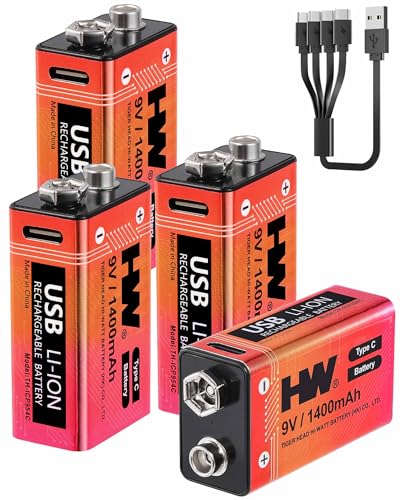
| HW 9V Lithium 4-Pack | Li-ion | 1400mAh per cell | 9V | Built-in USB-C port | High-capacity backup power |
| BATZONE 9V Lithium 2-Pack | Li-ion | 3700mWh per cell | 8.7V at full charge | Built-in USB-C port | Wireless microphones and pedals |
How to Choose
NiMH or Li-ion: Pick the Chemistry First
The first decision is chemistry, and it shapes everything else. NiMH 9V batteries are made from small 1.2V cells wired in series inside the familiar rectangular case, giving a nominal output close to 9V that falls gradually as the cell discharges. They are inexpensive, widely compatible, and tolerant of the slow, steady drain of smoke alarms and clocks. Li-ion 9V batteries use a different internal design, usually a single lithium cell stepped up or regulated to 9V output, and they hold their voltage steadier until the charge is nearly gone. That flat discharge curve is why Li-ion cells often feel stronger in wireless microphones and guitar pedals, but a device that warns of low battery by watching voltage may give less warning before a Li-ion cell cuts out. Low-drain devices that live on a shelf or ceiling for months suit NiMH; high-drain devices used in sessions usually suit Li-ion.
True Voltage Matters More Than the Label
Every battery in this guide is sold as a 9 volt battery, but the true voltage at full charge is not identical across chemistries, and the difference is worth understanding before you buy. A NiMH 9V pack typically measures around 9.6V fresh off the charger and drifts down toward 7.2V as it empties. A Li-ion 9V cell, by contrast, has a full-charge voltage set by its internal circuitry: the EBL pick below tops out at 8.4V, while the BATZONE pick reaches 8.7V, and the Quzmo and HW picks use regulated output that holds close to 9V until depletion. Most modern devices accept this range, but equipment with strict voltage cutoffs, older smoke alarms, and sensitive audio gear can behave differently on an 8.4V cell than on a 9.6V NiMH pack. Check your device manual for its acceptable range, and when in doubt, try one cell in a non-critical device first.
Capacity: Read mAh and mWh Carefully
Capacity tells you how long a battery runs before it needs charging, but the numbers on 9V listings are not always directly comparable. NiMH capacities are usually stated in milliamp-hours (mAh), and a typical 9V NiMH cell lands between 175mAh and 300mAh. Li-ion 9V cells often claim far larger numbers, from 600mAh up to 1400mAh, and some brands state capacity in milliwatt-hours (mWh) instead. The BATZONE pick, for example, is rated at 3700mWh, which converts to roughly 411mAh at 9V. When comparing two Li-ion cells, convert mWh to mAh by dividing by the voltage, or compare mWh to mWh. As a rule, higher genuine capacity means longer runtime, but be skeptical of headline figures far beyond what other cells in the same size achieve.
Charging Method: Charger, USB-C, or Separate Purchase
How you recharge the battery is a practical question that decides whether the pack is convenient or annoying. Some 9V rechargeables arrive with a dedicated charger in the box, such as the EBL 2-pack, which is the easiest starting point if you own no charger at all. Others, such as the Quzmo, HW, and BATZONE picks, have a USB-C port built into each cell, so you can top them up with a standard USB-C cable and skip a separate charger entirely. The Amazon Basics NiMH pick sits in the third group: the cells ship pre-charged and ready to use, but no charger is included, so you need a NiMH charger that supports 9V rectangular cells before the first recharge. Never charge a NiMH cell in a Li-ion charger, or the reverse; the chemistries need different charging profiles, and the wrong charger can damage the cell.
Self-Discharge and Cycle Life
Two numbers describe how long a rechargeable 9V stays useful: self-discharge and cycle life. Self-discharge is how fast a fully charged battery loses its charge while sitting unused, and it matters most for smoke alarms, emergency spares, and seasonal devices. Low self-discharge NiMH cells are built for this, with the Amazon Basics pick retaining 80 percent of its capacity after 24 months in storage. Li-ion cells generally hold their charge well too, with some listings quoting less than 1 percent of self-discharge per month. Cycle life is how many full charge and discharge cycles a cell survives before its capacity fades noticeably, and the picks in this guide are rated from several hundred cycles for basic NiMH cells up to 1000, 1200, or 1600 cycles for Li-ion cells. Treat cycle ratings as manufacturer claims, and expect real-world life to depend on discharge depth and charging heat.
Device Fit, Size, and Safety
A 9V battery is a standard size, but rechargeable cells are not always identical in dimensions to the alkaline they replace. Li-ion cells with a built-in USB-C port can be slightly larger than a plain alkaline, and a tight compartment in a microphone or guitar pedal may not accept them. Check the fit before committing to a full pack. Safety features are worth a look as well: overcharge, over-discharge, overcurrent, overheating, and short-circuit protection are commonly built into Li-ion 9V cells, and a smart charger with automatic shutoff adds another layer of protection. Store spares in a cool, dry place, keep terminals from touching metal objects, and recycle worn-out rechargeables at a collection point.
The Best Rechargeable Batteries 9 Volt Reviewed
1. Amazon Basics 9V NiMH 4-Pack
The Amazon Basics 9V NiMH 4-pack is the straightforward choice for low-drain household devices, and it is the only NiMH pick in this guide. Each cell is a nickel-metal hydride battery rated at 200mAh, with a nominal output of 9V, and the four-pack ships pre-charged so the cells are ready to use straight out of the box. The listing states the cells can be recharged up to 1000 times and retain 80 percent of their capacity for 24 months, suiting smoke alarms, remote controls, clocks, and toys that sit unused between uses. Capacity is modest next to the Li-ion picks, so runtime in a high-drain device will be shorter, and the voltage falls gradually as the cell discharges, which means a smoke alarm may chirp while the cell still holds some charge. The main limitation to plan around is that no charger is included, so you need a NiMH charger that supports 9V cells before the first recharge. For a household that wants a simple, affordable way to stop buying disposable 9V batteries for low-drain gear, this 4-pack is the easy starting point.
2. EBL 9V Li-ion 2-Pack with Smart Charger
The EBL 9V Li-ion 2-pack pairs two 600mAh lithium-ion cells with a dedicated smart charger, and it is the best option in this guide for buyers who own no charger at all. Each cell is a Li-ion battery with a full-charge voltage of 8.4V, lower than the nominal 9V on the label, so check that your device is happy with 8.4V before relying on it in a critical smoke alarm or voltage-sensitive instrument. The included C840 smart charger takes one or two cells at a time, uses LED indicators to show progress, and cuts off automatically to guard against overcharging. The 600mAh capacity is roughly three times the capacity of a standard 200mAh NiMH 9V, which translates into noticeably longer runtime in multimeters, wireless microphones, and smoke detectors. The two-cell pack suits a household with one or two 9V devices rather than a home full of them, and the cells must be charged in the supplied Li-ion charger, not a NiMH charger.
3. Quzmo 9V Li-ion 4-Pack
The Quzmo 9V Li-ion 4-pack is built for long runtime and simple charging, with a headline capacity of 1300mAh per cell and a USB-C port built into every battery. The cells use regulated output that holds close to 9V until the charge is nearly depleted, keeping wireless microphones and smoke alarms running steadily instead of fading gradually. The listing states more than 1200 recharge cycles, and each cell charges through a 2-in-1 USB-C cable with an LED indicator, so no separate charger is needed. Built-in protections cover over-temperature, overcharge, overload, and short circuits. Two cautions: the 1300mAh figure is a manufacturer claim measured at the internal cell voltage, so treat it as a comparison point; and the listing states these cells are not recommended for professional musical instruments, where some users report noise interference from the regulation circuitry. For everyday devices such as smoke detectors, alarms, toys, and microphones, the combination of high claimed capacity and cable-free charging makes this a strong all-round pick.
4. HW 9V Lithium 4-Pack
The HW 9V Lithium 4-pack offers the highest claimed capacity in this guide at 1400mAh per cell, with a USB-C port in each battery and a 4-in-1 charging cable included. The cells are lithium-ion with a 9V output, and the listing states up to 1600 recharge cycles along with overcharge, over-temperature, overload, and short-circuit protection. The pack suits households wanting backup power for smoke detectors, fire alarms, walkie-talkies, toys, game controllers, clocks, and security devices, and the four-cell count lets you rotate a fresh set in while the used set charges. As with the Quzmo pick, the 1400mAh capacity is a manufacturer claim that does not always translate directly into runtime at 9V, so compare it against the other Li-ion picks rather than taking the number at face value. Charging takes longer than the smaller-capacity cells, which is the natural trade-off for a larger cell, and the USB-C charging means no dedicated charger is required. For buyers who want the largest capacity figure available and the convenience of charging four cells from one cable, this is the pick.
5. BATZONE 9V Lithium 2-Pack
The BATZONE 9V Lithium 2-pack is the most performance-oriented pick in this guide, aimed squarely at wireless microphones, guitar pedals, and other gear that drains a battery quickly. Each cell is a rechargeable lithium 9V rated at 3700mWh, which converts to roughly 411mAh at 9V, with a full-charge voltage of 8.7V and a claimed cycle life of more than 1000 charges. A full charge takes around two hours through the built-in USB-C port with the included 2-in-1 cable, and an LED indicator shows when it is complete. The cells carry overcharge, over-discharge, overcurrent, overheating, low-temperature, and short-circuit protection. The 8.7V full-charge figure sits between the 8.4V of the EBL cells and the regulated 9V of the Quzmo and HW cells; most devices accept it, but voltage-sensitive equipment deserves a quick check first. The two-cell pack is the smallest count in this guide, so it fits a musician or presenter with one or two devices rather than a whole household. For high-drain use where steady voltage and fast USB-C recharging matter more than pack size, this is the pick.
What to Check Before You Buy
Before you buy, confirm four things and you will avoid most disappointments. First, confirm the chemistry your device and your charger support, because NiMH and Li-ion 9V cells cannot share a charger, and a cell charged the wrong way can be damaged. Second, confirm the true voltage, especially if your device is a smoke alarm with a low-battery chirp or a piece of audio gear with a strict cutoff; an 8.4V Li-ion cell and a 9.6V NiMH pack are both sold as 9 volt batteries, but they do not behave the same. Third, confirm the pack contents, since some listings include a charger, some only a USB-C cable, and some neither, and the missing piece can mean a second purchase. Fourth, confirm the fit, because Li-ion cells with a built-in USB-C port can be slightly larger than a disposable alkaline, and a tight compartment may not accept them. If you are switching a smoke alarm to rechargeable cells, test the alarm after fitting the battery and keep a spare charged set on hand, since a rechargeable that runs flat without warning is worse than a disposable that chirps for days.
FAQ
Are rechargeable 9 volt batteries safe to use in smoke alarms?
In most cases, yes, provided the cell fits the voltage and size requirements of the alarm and you follow the manufacturer’s guidance. NiMH cells are the traditional choice for smoke alarms because their voltage curve gives a long low-battery warning, while Li-ion cells hold voltage steady and then drop quickly, which can shorten the warning window. Whichever chemistry you choose, test the alarm after fitting the battery, replace cells on a schedule, and keep a charged spare available.
How long do rechargeable 9V batteries last between charges?
It depends on the device. A smoke alarm or a clock drawing a tiny current can run for months on one charge, while a wireless microphone or a guitar pedal can drain the same cell in a single session. Capacity is the main lever: a 600mAh Li-ion cell holds roughly three times the charge of a 200mAh NiMH cell, and a 1300mAh or 1400mAh cell holds more again, though manufacturer figures should be compared with care. Carrying a charged spare is the simplest way to avoid being caught out.
Can I charge a 9V Li-ion battery in a NiMH charger?
No. NiMH and Li-ion cells need different charging profiles, and using the wrong charger can damage the cell, shorten its life, or create a safety risk. Li-ion 9V cells should be charged in their supplied charger or through their built-in USB-C port, while NiMH 9V cells need a charger designed for NiMH 9V packs. When in doubt, use the charging method the battery maker specifies.
Why does my Li-ion 9V battery read 8.4V instead of 9V?
A Li-ion 9V cell uses lithium chemistry with internal circuitry that regulates output, and its full-charge voltage is set by that design rather than by the 9V label. Common full-charge figures are 8.4V and 8.7V, while some regulated cells hold close to 9V until they are nearly empty. Most devices accept this range, but equipment with a strict voltage cutoff may behave differently, so check your device manual if you are unsure.
How many times can a rechargeable 9V battery be recharged?
It varies by chemistry and quality. Basic NiMH 9V cells are typically rated for several hundred cycles, with the Amazon Basics pick rated up to 1000 cycles, while the Li-ion picks here are rated from 1000 to 1600 cycles. Real-world life depends on discharge depth, charging heat, and storage. Shallow discharges, moderate temperatures, and correct chargers all help a cell reach the upper end of its rated life.
Bottom Line
The best rechargeable batteries 9 volt depend on what you power. For low-drain household devices such as smoke alarms, clocks, and remote controls, the Amazon Basics NiMH 4-pack is the simple, proven choice, as long as you already own or buy a NiMH charger. For high-drain devices such as wireless microphones, guitar pedals, and multimeters, the Li-ion picks deliver longer runtime and steadier voltage, with the EBL 2-pack the easiest start thanks to its included charger, and the Quzmo and HW 4-packs the best value for multi-device households. Whichever you choose, match the chemistry to your charger, check the true voltage against your device, and read capacity figures with care, and a set of rechargeable 9V batteries will replace years of disposable purchases.
Disclosure: As an Amazon Associate, we may earn from qualifying purchases.