Key takeaways
- Four wireless smoker thermometers chosen from their Amazon listings, compared by range, probe count and alarms for brisket, pork butt and mixed cooks.
The real decision with a smoker thermometer is not whether it can show a number. It is whether you can trust it through a long, unattended cook without opening the lid every hour to check. A brisket that stalls at dawn, a pork butt that climbs faster than expected, or a fire that fades while you are inside all punish a weak signal, a single probe, or an alarm you cannot hear. Range, probe count, and how the receiver warns you matter more than a long list of extra modes.


This guide is for backyard smokers running offset, pellet, kamado, and drum smokers who want to step away from the cooker and still know what the meat and the pit are doing. Every model below was picked from the name and specifications stated on its own Amazon product page, and each one is a genuinely wireless design with a remote receiver or a phone connection, not a wired dial or a simple instant-read pen.
Quick Picks
As an Amazon Associate we earn from qualifying purchases.
| Product | Best for | Key spec from title |
|---|---|---|
| ThermoPro TP27 | Monitoring several cuts at once on a long cook | 500FT long range wireless with 4 probes |
| ThermoPro TP20 | A simple two-probe setup without an app | 500FT wireless with dual meat probe |
| ThermoPro TP28 | Two probes with a dedicated remote receiver | 500FT remote with dual probe |
| Inkbird IBT-4XS | Phone-based monitoring close to the smoker | Bluetooth wireless with 4 probes and 150 ft range |
How to Choose
Decide How Far You Actually Need the Signal to Travel
Range on the box is measured in open space, and a smoker in the backyard, a brick wall, and a sofa inside the house are not open space. Think about where you will really be during the cook. If the smoker sits at the far end of a garden and you plan to sleep through an overnight brisket, a long-range radio-frequency model such as the 500FT designs in this guide gives you headroom for walls and distance. If you cook on a patio a few steps from the kitchen and stay nearby, a shorter Bluetooth link can be enough, as long as you accept that wandering to the far side of the house may drop it.
Count Probes Against the Cook, Not the Marketing
One probe tells you about one piece of meat. A serious smoking session often needs more than that: one probe in the brisket flat, one in the point or a second cut, and ideally one clipped at grate level to show what temperature the meat is actually sitting in, which can differ a lot from the lid gauge. Two-probe models suit a single large cut plus the pit. Four-probe models earn their keep when a pork butt, ribs, and a chicken share the grate, or when two briskets cook side by side and finish at different times. Buy for the busiest cook you realistically run, not the quietest one.
Check the Alarm, Timer, and Preset Behaviour
On a twelve-hour cook, the alarm is the product. Look for a receiver that beeps and flashes when a preset temperature is reached, and for presets you can reset to your own targets rather than fixed factory numbers, because many smokers wrap a brisket well below the preset a manual suggests, or pull pork at a tenderness that no preset captures. A count-up and countdown timer helps with side dishes and with timing a rest in a cooler. Just as important is what happens at the stall: an alarm that only sounds once is easy to sleep through, so a repeating or vibrating alert on the receiver is worth more than another preset meat setting.
Separate the Meat Probe From the Pit Probe Job
Smoking asks two different questions: how hot is the meat, and how hot is the air around it. A good wireless setup lets you answer both at once, with one probe in the thickest part of the cut and another measuring ambient temperature at grate level. Check the stated temperature range and accuracy for the model, and check what the probe wires are rated to withstand where they cross a hot lid or door seal. A probe that reads the meat well but has a cable that cannot tolerate the heat at the smoker door will fail on exactly the long, hot cook you bought it for, so treat cable rating as a core specification, not a footnote.
The 4 Best Options
ThermoPro TP27
The TP27 fits the cook who runs more than one thing at a time. Its listing describes a 500FT long range wireless thermometer with four probes, for grilling and smoking, so a brisket, a pork butt, and a grate-level reading can all be watched from one receiver indoors. Four colour-coded probes, as the listing describes them, reduce the classic mix-up of pulling the wrong probe at wrapping time. It suits larger smokers and longer sessions where lifting the lid costs heat every time.
Specs
- Wireless range stated on the listing: 500FT long range
- Probes: 4 probes, described as colour-coded stainless steel probes
- Use stated in the title: for grilling and smoking, smoker, BBQ and grill
- Display: large digital backlit display, as stated in the listing title copy
- Alarm function stated in the listing copy
Best for: Cooks running two or more cuts plus a pit reading on an overnight or all-day smoke.
Watch out for: Four probes mean four cables to route through a lid or door seal, which takes a minute to arrange neatly on a small kettle or kamado.
ASIN: B081J6T3BZ
ThermoPro TP20
The TP20 is the straightforward two-probe choice for someone who wants a dedicated receiver and no app account, no pairing routine, and no phone dependency. Its Amazon listing describes a 500FT wireless meat thermometer with a dual meat probe, using radio frequency technology for a stronger signal and more stable connection, and it states that no synchronisation or app download is required. That makes it a good fit for a single brisket or pork butt where one probe follows the meat and the second watches the smoker, and for cooks who would rather glance at a receiver on the kitchen counter than unlock a phone with greasy hands.
Specs
- Remote range stated on the listing: up to 500 feet
- Temperature range stated on the listing: 14°F to 572°F
- Temperature accuracy stated on the listing: ±1.8°F
- Probes: dual probe, food-grade stainless steel probes with step-down tip design
- Probe wires stated on the listing to withstand up to 716°F
- Presets: USDA-recommended temperature settings, resettable to your own tastes
- Timer: count up and countdown setting stated on the listing
Best for: A single large cut plus pit temperature, monitored from indoors without using a phone.
Watch out for: With two probes, a third cut on the grate goes unmonitored, so busy mixed cooks will outgrow it.
ASIN: B01GE77QT0
ThermoPro TP28

The TP28 covers the same two-probe ground as the TP20 but through its own listing as a 500FT remote grill thermometer with dual probe, aimed at smoker, oven, and grill use. It suits the cook who mainly smokes one cut at a time, wants the long remote range to move around the house and yard freely, and prefers a matched transmitter and receiver pair over a Bluetooth app. Think of it for a weekend pork butt or a turkey, where the second probe can sit at grate level and warn you when the fire drifts before the meat temperature ever shows the problem.
Specs
- Wireless range stated in the title: 500FT remote
- Probes: dual probe, as stated in the title
- Use stated in the title: grill thermometer for smoker, oven and grill
- Product type stated in the title: wireless meat thermometer
Best for: One-cut smokes where you want long-range warning of a fading fire while you are indoors.
Watch out for: The listing evidence for this model is thinner than for the TP20, so check the current product page details carefully before ordering.
ASIN: B085KWD3CM
Inkbird IBT-4XS
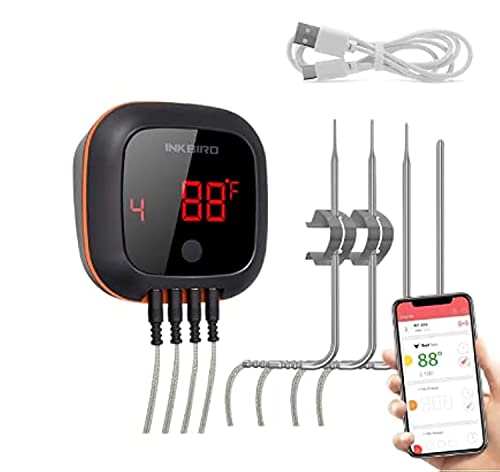
The IBT-4XS takes the phone-based route. Its listing describes a Bluetooth wireless grill BBQ thermometer with four probes, a timer, and an alarm, with a connecting distance of up to 150 ft, for smoker, oven, and drum cooking. Inside the box, the listing states three meat probes and one ambient probe, which maps neatly onto a mixed cook: two or three cuts plus the pit. The built-in rechargeable battery and magnetic back described on the listing suit a metal smoker body or drum where the base unit can sit on the cooker itself while you follow the cook on your phone nearby.
Specs
- Connectivity stated on the listing: Bluetooth wireless, connecting distance up to 150 ft / 50 M
- Probes: 4 probes, stated as 3 meat probes and 1 ambient probe
- Temperature range stated on the listing: 32°F to 572°F for short-time measurement, 32°F to 482°F for continuous monitoring
- Temperature accuracy stated on the listing: ±2°F
- Battery stated on the listing: built-in 1000mAh Li-Battery, USB charging cable included
- Design stated on the listing: magnetic design and large LED screen
Best for: Patio and drum smokers cooking near the house who prefer phone alerts and a rechargeable base.
Watch out for: The 150 ft Bluetooth range is the shortest here, so a smoker at the far end of a large yard may lose the link indoors.
ASIN: B076QDC5VL
Which One Fits Your Situation
You Smoke Overnight and Sleep Through the Stall
Choose the ThermoPro TP27 or TP20. Both state a 500FT range on their listings, which gives the signal a better chance of reaching a bedroom through walls, and both use a dedicated receiver rather than relying on a phone staying connected and charged all night. The TP27 adds probes for a second cut or an extra grate reading, while the TP20 keeps things simpler with two probes and resettable presets for the target you actually cook to.
You Cook Several Cuts at Once for a Group
Choose the ThermoPro TP27 if the smoker is far from the house, or the Inkbird IBT-4XS if it sits close by. Each offers four probes, so a brisket, a pork butt, and a chicken do not have to share a single reading. The difference is the link: the TP27 states the longer 500FT range with its own receiver, while the IBT-4XS sends readings to your phone over Bluetooth at up to 150 ft, which is fine for a patio cook where you stay nearby.
You Smoke One Cut at a Time and Hate App Setup
Choose the ThermoPro TP20 or TP28. Each is a two-probe wireless model with a matched receiver, and the TP20 listing states plainly that no synchronisation or app download is required. One probe goes in the meat, the other clips at grate level, and the receiver shows both. That is the whole job for a Saturday pork butt, and there is no account, no pairing failure, and no phone update waiting to interrupt the cook at the worst moment.
Your Smoker Sits Close to the Kitchen on a Patio
Choose the Inkbird IBT-4XS. At patio distance, its stated 150 ft Bluetooth range is not a practical limit, and you gain four probes, a rechargeable battery instead of disposable cells, and a magnetic base that can sit on a drum or metal smoker body. It is the natural pick for shorter, attended cooks like ribs and chicken, where you are in and out of the kitchen rather than asleep, and where phone alerts fit how you already work.
Common Mistakes
- Judging range by the number on the box without thinking about walls, brick, and distance between the smoker and the room you will actually sit in.
- Using every probe for meat and none for the pit, then wondering why the cook ran long when the grate temperature was far below the lid gauge reading.
- Leaving probe cables pinched hard in a lid or door seal on every cook, which wears the cable exactly where the heat is highest.
- Trusting a factory preset as the finish line instead of setting your own target and checking tenderness, especially for brisket and pork butt.
- Letting the receiver or phone go flat during an overnight cook, removing the alarm that was the whole reason for buying a wireless model.
Frequently Asked Questions
Do I really need a wireless thermometer for smoking?
For short, attended cooks, not strictly. For long smokes, it changes the cook: you stop opening the lid to check, and every lid lift on an offset or kamado dumps heat and adds time. A wireless model with a pit probe also warns you when the fire fades, which a quick instant-read check an hour later cannot do. If you smoke brisket or pork butt regularly, the remote warning is the main benefit, not convenience alone.
Is Bluetooth or a dedicated receiver better for a smoker?
It depends on distance and habit. A dedicated radio-frequency receiver, like the 500FT models here, is built for range and works without a phone. Bluetooth models send a richer display to your phone but state shorter ranges, such as 150 ft on the Inkbird listing. If your smoker is far from the house or you cook overnight, favour the receiver designs. If you cook close by and live on your phone anyway, Bluetooth is comfortable and simple.
How many probes should a beginner buy?
Two is the sensible starting point: one for the meat and one for grate-level pit temperature. That pair answers the two questions that decide a smoke. Four probes only pay off when you regularly cook several cuts at once. Buying four for a single weekly chicken adds cable clutter without adding useful information.
Where should the pit probe sit in the smoker?
Clip it at grate level, near the meat but not touching it, and not directly over the firebox inlet or a hot spot. The goal is the temperature the meat experiences, which can differ sharply from the lid gauge, especially on offsets where heat travels across the chamber. Keep it a short distance from the cold meat at the start, since a large chilled brisket can drag the reading right next to it down early in the cook.