Key takeaways
- Compare pond liners for aquaponics by material, thickness and sheet size, with four Amazon EPDM liners whose listings state fish-safe use for tanks and grow beds.
A pond liner inside an aquaponics system carries a heavier burden than the same sheet in an ornamental pond. It is not only holding water in a hole; it is the inner skin of a fish tank or sump where stock swim against it daily, where plumbing passes through or over it, and where a slow leak does not just lower a water feature — it drains the living half of a food-growing loop. The material against that water therefore matters more than the colour, the packaging or the size printed largest on the box.


This guide is written for backyard growers lining a fish tank, builders converting a dug sump or media bed, and anyone replacing a liner that perished or punctured mid-season. The liners below were selected from their Amazon listings, using the material, thickness and sheet dimensions stated there, and noting fish-safe wording only where the listing itself prints it — never assumed from the material name alone.
Quick Picks
As an Amazon Associate we earn from qualifying purchases
| Product | Best for | Key spec from title |
|---|---|---|
| Lifeguard 15 ft. x 15 ft. EPDM Pond Liner, 45-Mil | A square fish tank or sump named for aquaponics in its listing | 45-mil EPDM, aquaponics named in title |
| LifeGuard Pond Liner 15 ft. x 15 ft. 45 Mil EPDM and Underlayment Combo | Rough or stony ground under the tank | 45 mil EPDM with underlayment included |
| Firestone 45 mil EPDM Pond Liner 15′ x 25′ | A long tank or paired beds from one sheet | 45 mil EPDM in a 15 by 25 foot sheet |
| Firestone 5 x 15 PondGard 45 Mil EPDM Pond Liner | A narrow raceway, trough or grow bed channel | 45 mil EPDM in a 5 by 15 foot sheet |
How to Choose
Start with material, and read the fish wording on the listing
Aquaponics narrows the material question quickly, because the liner touches water that fish live in and plants feed from. Rubber EPDM sheets dominate this list because their listings state fish-safe use in plain language, which is the evidence that matters. A product page that never mentions fish tells you nothing either way, and a material name by itself is not a promise. Where a listing prints fish-safe wording, this guide repeats it and credits the listing. Where it does not, treat the liner as unproven for stock tanks and look elsewhere, however thick or inexpensive the sheet appears.
Treat thickness as puncture insurance
Thickness, stated in mil, decides how forgiving a liner is of the ground beneath it and the life above it. A forty-five mil sheet tolerates the small stones, root ends and frame edges that a thinner sheet may not, and it survives being walked on carefully during plumbing work. In an aquaponics build, that margin matters around bulkhead fittings, pump intakes and the corners of a tank frame, where the sheet folds and rubs. Thinner liners have their place in protected, fully supported beds, yet the listings gathered here sit at the heavier end, and for a fish tank that choice is deliberate rather than wasteful.
Size the sheet with the depth formula, not the footprint
A liner must cover the floor, climb both walls and leave an edge to anchor, so the flat size of a tank understates the sheet it needs. The listings here repeat a simple sizing approach: take the length, add twice the depth, then add an allowance for the edge, and do the same across the width. Run that arithmetic before choosing between the sheets in this guide. A fifteen foot square sounds large until a four foot deep tank consumes most of it on the walls alone, and a long sheet can serve a tank and a sump together if the layout is planned on paper first.
Plan folds, plumbing and protection underneath
A flat sheet in a square tank becomes a puzzle of folds, and each fold is a place where solids collect and material can chafe. Decide where the excess will gather — usually one or two corners — before water goes in, and keep plumbing entries away from folded stacks. What sits under the liner matters as much as the sheet itself: one pick here bundles underlayment for exactly this reason, cushioning the rubber against rough soil or concrete. Indoors or in a framed tank, smooth boards or foam under the sheet serve the same protective purpose and extend the liner’s working life.
The 4 Best Options
Lifeguard 15 ft. x 15 ft. EPDM Pond Liner – 45-Mil Rubber Liner for Outdoor Ponds, Waterfalls, Aquaponics, Retention Basins – Durable & Fish Safe
Few liners name aquaponics in their own title, and this LifeGuard sheet does, which makes it the natural anchor for a fish tank build. The square format suits a tank or sump of moderate footprint, folding into corners without the long trailing excess of a rectangular sheet. Its listing describes the material as flexible and puncture resistant, qualities that matter when a sheet must drape over a frame edge and settle into corners under the weight of water. For a grower lining one main tank, this is the sheet whose stated purpose matches the job most directly.
Specs
- Material listed: EPDM rubber
- Thickness listed: 45 mil
- Sheet size listed: 15 feet by 15 feet
- Fish wording on listing: fish safe stated in the title
- Aquaponics wording on listing: aquaponics named among its uses
- Model listed: LG15X15-45
Best for: A square fish tank or sump in a backyard aquaponics build.
Watch out for: Run the depth formula before ordering, because a deep tank can consume a surprising share of a fifteen foot sheet on its walls.
ASIN: B006SOJZT4
LifeGuard Pond Liner 15 ft. x 15 ft. 45 Mil EPDM Rubber and Underlayment Combo – CLGUG15X15
This combo answers the most common cause of liner failure: the ground underneath. By bundling underlayment with the same fifteen foot square of forty-five mil EPDM, it removes the separate hunt for a protective layer and the temptation to skip one. That pairing suits tanks dug into stony soil, sumps set on rough concrete, and any build where the base cannot be made perfectly smooth. The liner itself matches the first pick’s material and thickness, so the decision between them is purely about the surface your sheet will rest on and how much preparation that surface still needs.
Specs
- Material listed: EPDM rubber
- Thickness listed: 45 mil
- Sheet size listed: 15 feet by 15 feet
- Included listed: pond liner with underlayment
- Model listed: CLGUG15X15
Best for: Tanks and sumps sitting on rough, stony or uneven ground.
Watch out for: The underlayment adds bulk at the folds, so plan corner folds with the extra layer in mind before filling.
ASIN: B006SOKAC0
Firestone 45 mil EPDM Pond Liner 15′ x 25′
Length is this Firestone sheet’s contribution. At fifteen by twenty-five feet, one piece can line a long tank, a tank and an adjoining sump, or a pair of beds without a seam between them — and every avoided seam is an avoided leak path in a system that runs day and night. The listing states fish-safe use for this forty-five mil EPDM, which is the wording an aquaponics builder needs to see before trusting it with stock. It is a heavier sheet to handle, so installation becomes a two-person job of unfolding, centring and folding with the water partly in to settle the corners.
Specs
- Material listed: EPDM
- Thickness listed: 45 mil
- Sheet size listed: 15 feet by 25 feet
- Fish wording on listing: fish safe stated
- Model listed: FSPG15X25-45
Best for: A long tank, or a tank and sump lined from one continuous sheet.
Watch out for: A sheet this size is awkward to position alone, and trimming it early removes the option of lining a second vessel with the offcut.
ASIN: B002IUPTEC
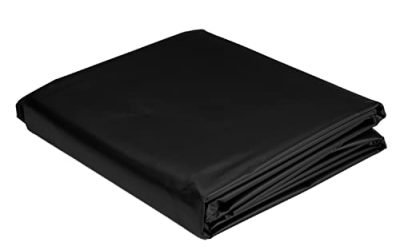
Firestone 5 x 15 PondGard 45 Mil EPDM Pond Liner Fish Safe, Flexible & Durable, Black

Not every vessel in an aquaponics layout is a tank. Raceways, troughs, radial-flow settlers and long grow channels need a narrow sheet, and cutting one from a wide liner wastes material and money. This five by fifteen foot Firestone strip keeps the same forty-five mil EPDM construction as its larger relatives in a shape that suits channels and troughs, and its listing states fish-safe use in its title. It also serves as a patch source or a liner for a quarantine and fry tank, the small second vessel many systems add once the main tank is running well.
Specs
- Material listed: EPDM, PondGard
- Thickness listed: 45 mil
- Sheet size listed: 5 feet by 15 feet
- Fish wording on listing: fish safe stated in the title
- Colour listed: black
- Model listed: W56PL4051015
Best for: Narrow troughs, channels and small secondary tanks in a larger system.
Watch out for: The five foot width limits depth once wall allowance is counted, so check the formula against your trough before relying on it.
ASIN: B004GX38OW
Which One Fits Your Situation
You are lining one main fish tank
Start with the Lifeguard fifteen foot square. Its listing names aquaponics directly, its thickness suits a vessel that will be drained, scrubbed and refilled over the years, and the square shape folds into a tank with manageable excess. Add the underlayment combo version instead if the tank sits on anything rougher than prepared, smoothed ground.
Your build sits on stony or rough ground
Choose the LifeGuard combo. The included underlayment cushions the sheet against the points and edges that cause slow punctures, which are the hardest leaks to find once a system is stocked and planted. Spending the effort underneath the liner is cheaper in time than emptying a fish tank later to hunt for a pinhole.
You want one sheet to cover tank and sump
Choose the Firestone fifteen by twenty-five. A continuous sheet removes the seam between vessels, and the spare length gives anchoring edge at both ends. Lay the whole layout out on paper with depths included before ordering, because this choice only works when the single sheet genuinely covers both vessels with edge to spare.
You are adding a trough, channel or quarantine tank
Choose the Firestone five by fifteen strip. Its narrow format lines long, shallow vessels without cutting down a wide sheet, and the stated fish-safe wording in its listing suits a quarantine tank holding stock. It is also the sensible spare to keep rolled in storage against the day the main liner needs a patch.
Common Mistakes
- Ordering a sheet from the tank’s footprint alone, forgetting that depth consumes liner on every wall and leaving no anchoring edge.
- Assuming a liner is safe for fish because of its material name, without the listing itself stating fish-safe use for that product.
- Skipping underlayment or base preparation on rough ground, then losing water slowly through a puncture hidden under the tank.
- Cutting a sheet to final size before filling, instead of letting water weight settle the folds and trimming the edge afterwards.
- Running plumbing or pump intakes against a folded corner, where constant rubbing wears the sheet at its thickest, stiffest point.
Frequently Asked Questions
Why does the listing’s fish-safe wording matter so much?
In aquaponics the liner is in permanent contact with the water your fish live in and your plants feed from, so the maker’s own statement is the evidence to rely on. Every pick in this guide repeats fish-safe wording only where its Amazon listing prints it. A listing that stays silent on fish leaves the question open, and open questions do not belong in a stocked tank.
Is 45 mil thick enough for a fish tank?
The liners gathered here are all listed at forty-five mil, a thickness their listings describe as puncture resistant and suited to ponds and water features. For a tank, what protects that thickness is preparation: a smooth base or underlayment beneath, and care around fittings and folds. Thickness and preparation work together, and neither fully replaces the other.
How do I work out the sheet size my tank needs?
Use the approach printed in these listings: add twice the depth to the length, plus an edge allowance, and repeat for the width. A tank twelve feet long and three feet deep therefore needs a sheet noticeably longer than twelve feet. Do the arithmetic for your deepest vessel first, then check whether one larger sheet could also cover a sump.
Can one liner serve both the tank and the grow beds?
It can, when the layout places the vessels together and the sheet is sized for the whole run, as with the fifteen by twenty-five foot Firestone here. A single sheet removes seams, yet it also makes later changes harder, because moving one vessel disturbs the other. Many growers line the fish tank with a full sheet and give beds their own liners for flexibility.