Our Short List of 3
All 3 Picks at a Glance
| Product | Specs | Action |
|---|---|---|
 ANCEL BA101 — the workshop-grade reporter | Check price on Amazon | |
 TOPDON BT100 — the clear, colour-screen middle ground | Check price on Amazon | |
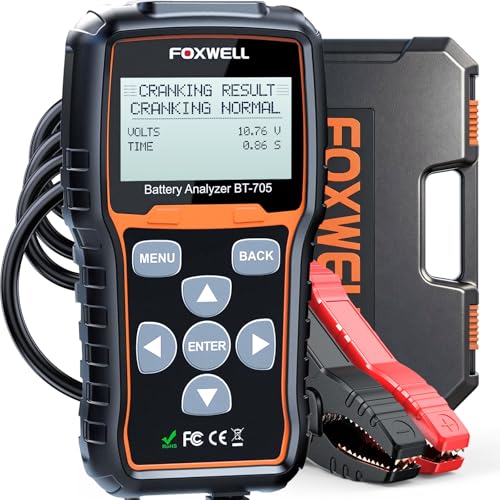 FOXWELL BT705 — the 12/24-volt option | Check price on Amazon |
Key takeaways
- A conductance tester reads a battery's health in minutes without a load bank. Three verified analyzers compared for range, battery types and reporting.
A battery tester answers the question every driver eventually faces in a car park: is this battery actually dying, or is something else wrong? Modern conductance testers answer it in about a minute, without discharging the battery, by measuring its internal resistance and comparing its real cranking capacity against the figure printed on its label. The result separates the three situations that feel identical from the driver’s seat — a battery at the end of its life, a healthy battery that is simply undercharged, and a charging-system fault that is killing good batteries — and each of those has a completely different fix and cost.
This guide compares three verified Amazon US analyzers that cover the category’s sensible range: a workshop-grade unit with printed reports, a colour-screen tester that balances features and simplicity, and a 12/24-volt unit for households and small fleets with mixed vehicles. All three test the battery, the cranking system and the charging system, which is the full diagnostic picture; a tester that only reports voltage tells you almost nothing, because a dying battery can show a healthy voltage at rest and collapse the moment it is asked to work.
Disclosure: As an Amazon Associate, this site may earn from qualifying purchases made through links in this article, at no additional cost to you.
How conductance testing works — and its limits
A conductance tester sends a small signal through the battery and measures the response, from which it estimates the battery’s state of health: its remaining capacity as a share of its rated capacity, alongside state of charge and internal resistance. You enter the battery’s rated CCA and type — flooded, AGM, gel or EFB — and the tester does the comparison. The method’s great virtue is that it works on a battery in the vehicle, quickly, without a full charge or a load bank.
Its limits deserve equal honesty. A conductance reading is an estimate, and a battery that has just been charged can flatter itself; the most reliable reading comes from a battery that has rested, ideally for several hours after driving. Surface charge can mislead, which is why good practice is to switch the headlights on briefly before testing a freshly driven car, or simply test in the morning. And a tester diagnoses the battery and the charging system — it does not find parasitic drains or failing starters, though its cranking test narrows the field considerably. Used with those caveats, it is the most cost-effective diagnostic tool a car owner can buy, because it prevents the two expensive errors: replacing a good battery, and trusting a bad one.
The picks
ANCEL BA101 — the workshop-grade reporter
The ANCEL BA101 (ASIN B01M0ARG3X) is the most complete tester of the three. It covers 12-volt batteries from 100 to 2000 CCA across flooded, AGM, gel and VRLA types, runs the full trio of tests — battery health, cranking and charging — and adds the feature that separates workshop tools from glovebox gadgets: it stores results and prints a report through a USB connection to a computer. For a small workshop, a fleet keeper, or an owner who wants a dated record of a battery’s decline across seasons, that paper trail is genuinely useful.
The BA101’s manner is professional rather than friendly: a text display, menu-driven operation, and results expressed in the measurements themselves — CCA delivered versus rated, internal resistance in milliohms, state of health as a proportion. If you want to understand your battery rather than be told a verdict, this is the pick. Its honest limit is that the print function ties it to a computer, which suits a workshop better than a roadside. For a home mechanic who keeps records — and this guide argues every battery owner should — that limit reads more like a feature, because a printed, dated result filed with the vehicle’s paperwork is exactly the trend record the later sections recommend building.
TOPDON BT100 — the clear, colour-screen middle ground
The TOPDON BT100 (ASIN B07Z67MMGC) covers the same 100–2000 CCA range and the same core tests, presented on a colour screen with the results organised around plain verdicts alongside the numbers — state of health and state of charge shown prominently, with the cranking and charging tests a menu step away. For the owner who will test a family fleet twice a year rather than customer cars daily, that presentation is the difference between a tool that gets used and a tool that stays in its box.
The BT100 suits the household diagnostician: several cars, perhaps a mower and a boat battery, and a wish to know before winter which of them is living on borrowed time. It gives up the ANCEL’s printing and some of its workshop depth, and in exchange is quicker to read and harder to misread. Both trade-offs are legitimate; choose by how often you will test and how much you enjoy the numbers.
FOXWELL BT705 — the 12/24-volt option
The FOXWELL BT705 (ASIN B01ANF1D7U) extends the same diagnostic brief to 24-volt systems as well as 12, which makes it the pick for households and small operations with a truck, an RV with a series pair, agricultural equipment or a boat with a 24-volt bank. It covers 100–2000 CCA, tests battery, cranking and charging systems, and connects with a notably long cable — just under six feet — that makes testing batteries in awkward engine bays and battery boxes a one-person job rather than a stretch.
For a pure 12-volt household, the BT705’s extra range is headroom you may never use, and either pick above will serve. For anyone who has ever needed to test a 24-volt system and discovered their tester could not, the FOXWELL is the one that ends that problem, and its build is aimed at working environments rather than occasional glovebox duty.
How to get a reading you can trust
Four habits separate a useful test from a misleading one. Test a rested battery where you can — first thing in the morning is ideal. Enter the specification correctly: the CCA figure and the standard it follows are printed on the battery’s label, and an AGM entered as a flooded battery will be judged against the wrong expectation. Connect to clean terminal posts, not corroded clamps; a poor connection adds resistance the tester will blame on the battery. And act on the trend, not a single borderline reading: a battery that tests at a healthy level in autumn and noticeably lower in spring is telling you its schedule, and replacing it before the season that strands you is the entire point of owning the tool.
Record your results. A dated note of state of health for each battery you own turns one-off tests into a maintenance picture, and it is the habit that makes any of these three testers pay for itself. Twice a year is enough for most households — once in autumn, before the cold arrives to expose weak batteries, and once in spring — and the two minutes each test takes is the cheapest insurance in car ownership.
Reading the three numbers like a technician
A tester report reduces to three figures, and each deserves a plain explanation. State of charge is the simplest: how full the battery is right now, expressed as a share of its capacity and reflected in its resting voltage. A low state of charge is not a verdict — it is a instruction to charge the battery and test again, because health cannot be judged fairly on a depleted battery.
State of health is the verdict: the battery’s remaining capacity as a share of what it had when new. Batteries do not fail on a schedule; they fade, and state of health is the fade made visible. A battery in the upper ranges is trustworthy. One in the middle ranges is a planning problem — fine for now, first in line for replacement before the season that punishes weakness. One in the low ranges is already living on borrowed starts, and its next cold morning is a coin toss.
Internal resistance is the figure technicians watch most, because it rises as plates sulfate and active material sheds, and it predicts cranking behaviour better than voltage alone. A rising resistance trend across your own recorded tests, on the same battery, is the clearest early warning the tool provides — clearer than any single reading, which is why the record-keeping habit recommended above matters. The cranking and charging tests complete the picture: the cranking test watches voltage under the starter’s load, where a weak battery or a tired starter each leave a different signature, and the charging test confirms the alternator and regulator are holding system voltage where they should, neither undercharging the battery into an early grave nor overcharging it into one. Read together, the five results turn “the car would not start” from a mystery into a shortlist, and that is the entire value of the category.
Tester, charger or jump starter?
The categories complement rather than replace each other. A tester diagnoses. A maintainer or charger restores and preserves charge. A jump starter rescues. The diagnostic step is the one most often skipped, and skipping it is how healthy batteries get replaced for a charging fault and dying batteries get charged repeatedly instead of replaced once. If you can only add one tool, the tester is the one that tells you which of the others you actually need.
Which standard, which setting: a short note on CCA figures
One detail trips up first-time users and deserves its own paragraph. Battery capacity is quoted under several national standards — CCA, SAE, EN, DIN and others — and the same battery carries different numbers under each. Every tester here asks you to select the standard as well as the figure, and the pair must match what is printed on the battery’s label. Entering an EN figure while the tester is set to CCA judges the battery against a converted expectation it was never rated under, and the verdict that follows says more about the mismatch than the battery. Take the extra ten seconds to read the label fully, match both the number and the standard, and note the pair in your records so the next test starts from the same baseline.
Bottom line
The ANCEL BA101 is the pick for depth and printed records, the TOPDON BT100 for clarity and household ease, and the FOXWELL BT705 for anyone whose world includes 24-volt systems. All three are verified Amazon US listings, all three test battery, cranking and charging as a complete picture, and all three will pay for themselves the first time they stop you replacing the wrong part.