Our Short List of 3
- No wiring needed, so it installs in any room
- Spoken alerts name the hazard and the room
- Phone notifications through the Google Home app
- Automatic self-checks with app status reports

- Mains power with battery backup, so no routine battery swaps
- Direct replacement for existing hardwired alarm boxes
- Voice alerts and phone notifications through Google Home
- Interconnects with other Nest Protect alarms

- Built-in Alexa speaker and Apple HomeKit support
- Photoelectric smoke plus electrochemical CO sensing
- Hardwired interconnect with other Onelink and many BRK alarms
- Nightlight and app controls for alerts and CO levels
All 3 Picks at a Glance
| Product | Specs | Action |
|---|---|---|
| Google Nest Protect, Battery Operated |
| Check price on Amazon |
| Google Nest Protect, Wired |
| Check price on Amazon |
| First Alert Onelink Safe and Sound |
| Check price on Amazon |
Key takeaways
- Best tech smoke detectors for a smarter home: Wi-Fi alarms with voice alerts, phone alerts and whole-home interconnect, from Nest, First Alert and X-Sense.
Introduction
The best tech smoke detectors do more than sound a siren when something burns. They tell you what is happening and where, send an alert to your phone when you are away from home, and trigger every alarm in the house at once so a fire in the basement wakes the bedrooms upstairs. That is the difference between a basic alarm and a smart one, and it is the standard this guide uses.
The keyword behind this guide is vague, so here is the interpretation it follows: “tech” means smart, connected smoke detectors. Every product below connects to Wi-Fi or a smart home app, gives spoken voice alerts that name the danger and the room, or interconnects wirelessly with other alarms. A plain battery alarm with no connectivity does not qualify, no matter how loud it is. Most of the picks below also detect carbon monoxide, because a combined smoke and CO alarm covers two hazards with one ceiling device, and that is how most buyers shop for this category.
This guide is for homeowners replacing ageing alarms, renters who want phone alerts without rewiring, and anyone rebuilding a system after the Nest Protect line was discontinued. It covers how to choose between battery and hardwired power, which smart features actually matter, and four connected alarms that are listed on Amazon US: two Nest Protect models, the First Alert Onelink Safe and Sound, and a three-pack Wi-Fi combo from X-Sense. Listings were corroborated through Amazon search results and independent sources; live stock could not be checked directly, so confirm current availability on the listing before buying.
At a Glance
| Product | Best for | Key spec |
|---|---|---|
| Google Nest Protect, Battery (B00XV1RCRY) | Homes without alarm wiring | Battery powered smoke and CO alarm with voice alerts and phone notifications |
| Google Nest Protect, Wired (B00XV1RD0K) | Replacing existing hardwired alarms | 120V hardwired smoke and CO alarm with voice alerts and phone notifications |
| First Alert Onelink Safe and Sound (B077Y6CL7M) | Apple Home households that want a speaker too | Hardwired smoke and CO alarm with Alexa speaker, HomeKit support and nightlight |
| X-Sense SC07-WX, 3-Pack (B0CFKNFTC7) | Covering several rooms on a budget | Wi-Fi smoke and CO combo with replaceable batteries and app alerts, three units |
How to Choose a Tech Smoke Detector
Power source first. Battery alarms install anywhere with screws and a ladder, which makes them the right choice for rooms with no alarm wiring, rented homes, and apartments. Hardwired alarms draw mains power with a battery backup, so they never depend on a single set of cells, and they interconnect over the wiring in many homes. If your ceilings already have hardwired alarm boxes, a hardwired replacement is usually a quick swap. If they do not, a battery smart alarm avoids opening ceilings and calling an electrician.
Smoke and CO in one device. A combination alarm detects smoke and carbon monoxide together. CO is colourless and odourless, and it comes from faulty furnaces, water heaters, gas stoves and attached garages. Buying a combo unit means one device, one install and one app entry per room instead of two. Every product in this guide is a smoke and CO combination alarm.
Voice alerts that name the room. A siren tells you something is wrong. A voice alert tells you what and where: “Smoke detected in the kitchen” is far more useful at 3 a.m. than a tone you have to interpret. Voice location alerts also help households with children or older relatives, because the alarm explains the danger instead of only making noise. Check whether the alarm speaks the room name or only the hazard type.
Phone alerts and remote silence. Wi-Fi connectivity sends a notification to your phone when an alarm triggers while you are out, and it warns you about low batteries before the chirping starts. Some apps also let you silence a nuisance alarm from cooking smoke without climbing onto a chair. This is the single most practical smart feature, and it is worth more than most other extras.
Interconnect, so one alarm wakes the whole house. When alarms interconnect, one triggering unit sets off all the others. Wireless interconnect does this over Wi-Fi or a radio link; hardwired interconnect does it over the mains wiring. Either way, a fire downstairs should sound upstairs. If you are buying several units, confirm they interconnect with each other before ordering, because mixing brands can break the chain.
Smart home platform. Nest Protect works with the Google Home app. The First Alert Onelink Safe and Sound supports Apple HomeKit and Alexa. The First Alert SC5, the newer Google Home alarm, is the official Nest Protect successor, but no ASIN for it could be corroborated, so it is not reviewed here. The X-Sense models use the X-Sense Home Security app. Pick the alarm that matches the platform your household already uses, because an alarm on a platform nobody opens is just an expensive siren.
Product Reviews
Google Nest Protect, Battery Operated
- No wiring needed, so it installs in any room
- Spoken alerts name the hazard and the room
- Phone notifications through the Google Home app
- Automatic self-checks with app status reports
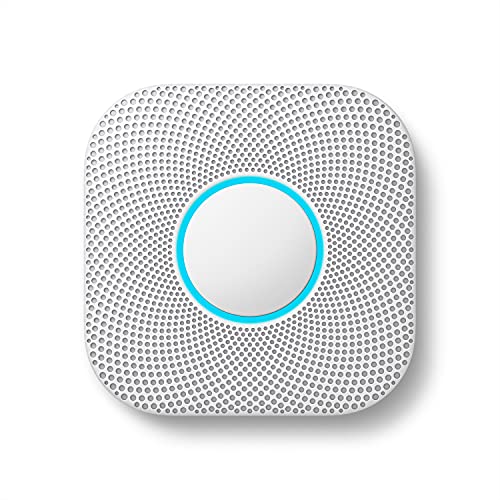
The battery version of the Nest Protect is the simplest way to add a smart smoke and CO alarm to a room with no wiring. It runs on batteries, mounts on the ceiling with the included bracket, and connects to the Google Home app for phone alerts. Its square body with a perforated grille and a coloured light ring is easy to recognise, and the voice alerts speak the hazard and the room in plain language.
Key specs from the listing: battery operated smoke and carbon monoxide alarm; spoken voice alerts; phone notifications through the Google Home app; automatic self-checks that run in the background; split-spectrum smoke sensing; part number S3000BWES; model A11. It interconnects with other Nest Protect alarms, so one alarm sounding can set off the rest of the system.
This is the best fit for renters, apartments, and any room where running mains wiring is not an option. It also suits households that already use Google Home, since the alerts land in the same app as the rest of the smart home. The main limitation is the one every Nest Protect buyer should know: Google discontinued the Nest Protect line and partnered with First Alert on the SC5 as its successor. Existing Protect units keep working, and listings for the battery model still appear on Amazon US, but buyers should confirm current availability and support terms on the listing before ordering several units for a whole house.
Pros
Cons
Google Nest Protect, Wired
- Mains power with battery backup, so no routine battery swaps
- Direct replacement for existing hardwired alarm boxes
- Voice alerts and phone notifications through Google Home
- Interconnects with other Nest Protect alarms
The wired Nest Protect is the same smart alarm with mains power. It connects to a 120V hardwired alarm circuit, so it draws power from the house wiring and uses its battery only as a backup. For homes that already have hardwired alarm boxes, this is a direct replacement: remove the old unit, connect the new one, and the smart features come with it.
Key specs from the listing: 120V hardwired smoke and carbon monoxide alarm with battery backup; spoken voice alerts; phone notifications through the Google Home app; automatic self-checks; split-spectrum smoke sensing; part number S3003LWES; model A12. It interconnects with other Nest Protect units over the hardwired line and wirelessly, so a trigger in one room sounds the alarms elsewhere in the home.
This is the best fit for homeowners replacing an existing hardwired system who want to keep mains power and gain phone alerts and voice location announcements. The same discontinuation caveat applies as with the battery model: Google has ended the line, so check the listing for current availability and confirm how the alarm will be supported before buying a full set. Where the wiring already exists, though, the wired Protect remains one of the most polished smart alarms available.
Pros
Cons
First Alert Onelink Safe and Sound
- Built-in Alexa speaker and Apple HomeKit support
- Photoelectric smoke plus electrochemical CO sensing
- Hardwired interconnect with other Onelink and many BRK alarms
- Nightlight and app controls for alerts and CO levels
The Onelink Safe and Sound is the most feature-packed alarm in this guide. It is a hardwired smoke and CO alarm with a built-in premium speaker and Alexa, so the ceiling device doubles as a room speaker, an intercom and a voice assistant. It also works with Apple HomeKit, which makes it the natural pick for Apple households that the Google-centred Nest Protect never served well.
Key specs from the listing: 120V hardwired with battery backup; photoelectric smoke sensor and electrochemical CO sensor; built-in Alexa speaker; Apple HomeKit support; customisable nightlight; voice alerts that name the danger and its location; remote notifications, CO level tracking and nightlight controls through the Onelink Home app; 3-year limited warranty; model 1039102; listed to UL 217 and UL 2034. It interconnects over the hardwired line with other Onelink and many BRK alarms.
This is the best fit for a hardwired home where someone wants Alexa in the room anyway, or for an Apple Home household that wants alarm alerts inside the Home app. The speaker is genuinely useful for music and voice commands in a bedroom or kitchen, and the nightlight is a small touch that owners tend to like. The limitations are real too: it only works where hardwired alarm boxes exist, there is no battery-only version, and the speaker pushes the cost well above an alarm-only unit. It is a premium pick, and it should be judged as one.
Pros
Cons
X-Sense SC07-WX, 3-Pack
ASIN: B0CFKNFTC7
The X-Sense SC07-WX is the value pick in this guide, and the three-pack format is the point: three Wi-Fi smoke and CO alarms for the cost of roughly one premium unit, which makes whole-home coverage realistic for more households. Each unit connects directly to 2.4 GHz Wi-Fi and sends real-time notifications to the X-Sense Home Security app, so a trigger at home reaches your phone anywhere.
Key specs from the listing: Wi-Fi smoke and carbon monoxide combination alarm; real-time app notifications; replaceable CR123A batteries, with six included for the three-pack; model SC07-WX; sold by X-Sense US and shipped from Amazon. The units are designed to work together as a set, so one pack covers a hallway, a bedroom and a living area without buying three separate alarms.
This is the best fit for buyers covering several rooms on a sensible budget, for landlords fitting out a rental, or for anyone who wants app alerts without paying for a voice assistant speaker in the ceiling. The replaceable batteries are a practical advantage over sealed-battery designs: when a cell runs low, you swap it instead of replacing the whole alarm. The trade-off is the absence of the extras the premium picks offer: no built-in speaker, no HomeKit, and no Google Home integration, so the app is the X-Sense one rather than the smart home platform you may already use.
Pros
- Three Wi-Fi alarms in one pack for whole-home coverage
- Real-time phone alerts through the X-Sense app
- Replaceable batteries instead of a sealed cell
- The most affordable route to connected alarms in this guide
Cons
- No built-in speaker or voice assistant
- No Apple HomeKit or Google Home integration
- App experience is tied to the X-Sense platform
Which One Fits You
Choose the Nest Protect battery model if you have no alarm wiring and want the most polished app experience in the Google ecosystem, and accept that the line is discontinued. Choose the wired Nest Protect if your ceilings already have hardwired boxes and you want mains power with the same features. Choose the First Alert Onelink Safe and Sound if you live in the Apple world, want Alexa in the ceiling, and are happy to pay for a speaker alongside the alarm. Choose the X-Sense SC07-WX three-pack if you need to cover several rooms and want Wi-Fi alerts without the premium cost, and you are comfortable using the X-Sense app. In every case, match the alarm to your wiring and your platform first; the smart features only help if they reach the phone and the app you actually use.
FAQ
Do tech smoke detectors need Wi-Fi to work as alarms?
No. The siren and the sensors work without Wi-Fi. Wi-Fi adds phone alerts, remote silence and status reports. If the internet goes down, the alarm still sounds in the room.
Should I buy a smoke-only alarm or a smoke and CO combination?
A combination alarm covers both hazards with one device and one install. Every pick in this guide is a combination alarm, and that is the simpler choice for most rooms.
Can I mix brands in one interconnected system?
Usually not. Interconnect generally works between compatible models from the same brand family. The SC5 is designed to interconnect with Nest Protect, and Onelink units interconnect with many BRK alarms, but mixing unrelated brands is not a reliable plan.
Is the Nest Protect still worth buying after Google discontinued it?
It depends on your plans. The hardware and the app still work, and listings remain on Amazon US. If you are building a new whole-home system, the First Alert SC5 is the official successor, so weigh the Protect against it before committing to several units.
How many smart smoke detectors does a home need?
Fit one in every bedroom, one outside each sleeping area, and one on every level including the basement. Kitchens need care too, but place the alarm away from the stove to reduce nuisance triggers from cooking.
What is the difference between a voice alert and a siren?
A siren is a tone that signals danger. A voice alert speaks the hazard and the room, such as smoke in the kitchen, which helps everyone in the house understand what is happening without having to investigate first.
Conclusion
A tech smoke detector earns its place by telling you more than a siren can: what the danger is, which room it is in, and whether it is happening while you are away. Battery buyers should start with the Nest Protect battery model, hardwired homes should look at the wired Protect or the Alexa-equipped First Alert Onelink Safe and Sound, and anyone covering several rooms on a budget should consider the X-Sense SC07-WX three-pack. Confirm current availability on the Amazon listing before ordering, match the alarm to your wiring and smart home platform, and replace ageing alarms before they fail rather than after.
Disclosure: As an Amazon Associate, we earn from qualifying purchases.