Key takeaways
- Compare the best outdoor mast tv antennas for free over-the-air channels: mast-ready Yagi and multi-directional picks, range guidance, and install tips.
A mast-mounted outdoor antenna is still the most reliable way to watch free over-the-air television. Mounted high on a roof mast, eave, or pole, an outdoor antenna clears the roofline, trees, and walls that weaken indoor reception, and it can pull in local network, news, sports, and public broadcast channels without a monthly bill. The catch is that not every outdoor antenna is built for a mast: some need a flat surface or wall bracket, some ship without mounting hardware, and some are so heavy or wide that a light mast will flex in the wind. This guide covers only antennas genuinely made to mount on a mast, with the hardware to do it, comparing four mast-ready models by range, direction, and mounting hardware.

The four picks below all share the same basics: VHF and UHF reception, support for 4K and 1080p broadcasts, weather-resistant construction, and a mast clamp or J-mount in the box. They differ in range, directionality, and size: a directional Yagi suits towers in one direction, while a multi-directional design suits scattered towers. Range figures are the manufacturers’ stated ratings, and real-world reception depends on distance, terrain, trees, and mast height, so treat any mileage claim as a starting point.
Before you buy, check where your local transmitters sit. Free tower maps and signal-finder apps show the direction and distance of each station, which decides whether you need a directional or multi-directional model and how high the mast should be. A few extra feet of height often helps more than a larger antenna. Also plan the cable run: confirm whether a cable is included or you need an RG6 run, and plan for grounding and weatherproofing the connection.
As an Amazon Associate, we earn from qualifying purchases.
Quick Picks
Our Short List of 3

All 4 Picks at a Glance
| Product | Specs | Action |
|---|---|---|
| 1. GE Outdoor HD Digital TV Antenna 29884 — Best for a First Mast Install | Check price on Amazon | |
| 2. Antennas Direct ClearStream 4V — Best for Towers in Several Directions | Check price on Amazon | |
| 3. RCA ANT751E Compact Outdoor Yagi — Best Compact Directional Mast Mount | Check price on Amazon | |
 4. GE Outdoor Yagi TV Antenna 33685 — Best for Long-Range Single-Direction Reception | Check price on Amazon |
1. GE Outdoor HD Digital TV Antenna 29884 — Best for a First Mast Install
The GE 29884 is the safe starting point for a mast install, covering the common suburban case with no extra parts to buy for the mount. It is a compact directional antenna rated for reception within 70 miles, handling both VHF and UHF channels, the two bands local stations use. The listing describes support for 4K Ultra HD and Full HD 1080p broadcasts, and the weather-resistant design suits outdoor use, with attic mounting as an alternative if a roof mast is not practical.
The included J-mount is what makes this model so easy to live with on a mast. The box contains the mounting bracket, mast clamp, and J-mount hardware, so the antenna can go straight onto a wall, roof, or standard mast. At 29 inches by 20.5 inches it presents a modest profile to the wind and does not demand a heavy-duty mast. The design uses signal-enhancing reflectors, and the listing notes support for multiple televisions through a coax splitter, which suits a whole-home setup.
There are two limits worth knowing. First, this is a directional antenna, so it needs to be aimed at the tower cluster, and if your stations sit in very different directions you may need to choose the strongest cluster or add a rotator later. Second, it is a passive design with no built-in amplifier, which is fine for suburban distances but means very weak fringe signals may need a separate preamplifier. For most homes within 70 miles of their towers, the 29884 is a low-risk first pick.
2. Antennas Direct ClearStream 4V — Best for Towers in Several Directions
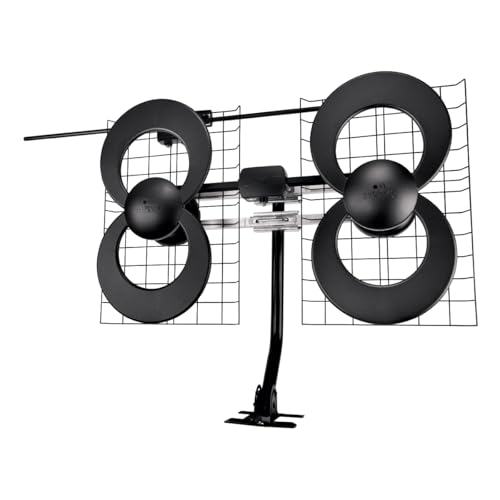
The Antennas Direct ClearStream 4V is the pick for homes where the broadcast towers do not all sit in one direction. This multi-directional antenna is built around four patented loops, with Hi-VHF elements and reflectors, and is rated for reception over 70 miles. Unlike a narrow Yagi, the 4V accepts signals from a wider arc, so a household with stations scattered across the compass can often use one fixed mast position instead of aiming at one cluster and losing another.
The mast hardware is a genuine strength. Model C4-V-CJM includes a 20-inch mast with a pivoting base, mounting hardware, an adjustable clamp, and sealing pads, making it straightforward to set the right angle on a sloped surface. At 4.1 pounds it is light enough for a single standard mast, and the 75-ohm impedance matches standard coax without an adapter. The listing describes it as 4K ready for indoor, attic, or outdoor placement, and the loop design with reflectors is intended to increase range while cutting interference from behind.
One point of care is the naming: the closely related ClearStream 4 is a UHF-only design with a different identifier. The 4V here is the UHF and VHF version with the pivoting mast base, so confirm model C4-V-CJM before ordering. The 4V is also passive, so in a deep-fringe location a preamplifier may still be needed. For suburban and semi-rural homes with towers in more than one direction, the 4V is one of the most flexible mast antennas available.
3. RCA ANT751E Compact Outdoor Yagi — Best Compact Directional Mast Mount
The RCA ANT751E is a compact Yagi for households whose towers cluster in one direction and who want a light, quick-to-aim antenna on the mast. It is rated for reception up to 70 miles or more, handles both UHF and VHF stations, and supports 4K, 8K, and 1080p broadcasts. The Yagi layout is a long boom with stacked elements that focus reception hard in one direction, giving it strong gain for its size when pointed correctly.
The weight is the headline: the ANT751E is built on a 2-pound frame, one of the lightest mast antennas in this guide, putting very little load on the mast, clamp, and roof. That lightness also suits an attic install. The design arrives pre-assembled, with an easy-lock fold-out UHF reflector and snap-lock elements, so assembly on the ground before raising the mast is quick. The box includes the mast, a locking mast clamp, mounting hardware, and a 75-ohm matching transformer, and the free RCA Signal Finder app works as a digital compass pointing toward the strongest channel cluster.
The main thing to budget for is the cable: coax is sold separately, so buy an RG6 run before install day. The antenna is directional, so it rewards careful aiming and will not suit a home whose towers sit in opposite directions without a rotator. As a passive design with no amplifier, fringe reception depends on height and a clear line of sight. For a home with a single tower cluster and a straightforward coax run, the ANT751E delivers focused directional reception in a compact, lightweight package.
4. GE Outdoor Yagi TV Antenna 33685 — Best for Long-Range Single-Direction Reception
The GE 33685 is the long-range Yagi in this guide, the pick when the towers are far away but all sit in roughly the same direction. This Yagi-style antenna is rated for reception within 80 miles, the longest stated range of the four picks here, and supports VHF and UHF channels, 4K and 1080p broadcasts, and NEXTGEN TV through ATSC 3.0 compatibility. The listing notes support for up to 200 channels, the count available in a strong-signal area rather than a guarantee at any single address.
The build is a genuine rooftop fixture: 37 inches long by 26.5 inches wide by 19 inches high, and just over 3 pounds, larger than the compact GE 29884 but still manageable on a standard mast. The box includes a weather-resistant mounting bracket, mast clamp, and J-mount, and the impedance is 75 ohms for a direct connection to standard coax. It can also be installed in an attic, although a mast position will generally give better results. GE backs the model with a limited lifetime replacement pledge and free technical support.
As with the other Yagis here, direction matters: the 33685 focuses its gain in one direction, so it needs aiming at the tower cluster, and homes with stations in widely separated directions should look at a multi-directional model such as the ClearStream 4V instead. It is also passive, so in an extremely weak signal area an inline amplifier may help, and the stated 80-mile range will fall short in heavily wooded or hilly terrain. For a rural home with a clear bearing to a distant tower cluster and a solid mast, the 33685 is the strongest single-direction pick in this roundup.
Buying Guide: How to Choose an Outdoor Mast TV Antenna
Start with your towers, not the antenna
Find out where your local transmitters are and how far away they sit. Free tower maps and signal-finder apps show the direction, distance, and band of each station, and that picture decides almost everything else. If every station you want sits within a narrow arc, a directional Yagi will give you the most gain; if stations are spread around the compass, a multi-directional antenna saves you from choosing between them or buying a rotator. Compare the distance to your farthest station with each antenna’s stated range, remembering that the range assumes a clear line of sight.
Directional versus multi-directional
Directional antennas such as the two GE Yagis and the RCA ANT751E concentrate reception in one direction, giving stronger gain on the stations they are aimed at and better rejection of interference from behind. The trade-off is aiming: a small error can cost channels. Multi-directional antennas such as the ClearStream 4V accept signals from a wider arc, making them more forgiving to aim and better for scattered towers, at the cost of lower peak gain in any single direction. Neither type is better in general; the right one depends on the layout of towers around your home.
Range claims and what they really mean
The numbers in this guide run from 70 to 80 miles. Treat these figures as a comparison tool rather than a guarantee: a 70-mile antenna on a tall mast with a clear view of the tower will often outperform an 80-mile antenna mounted low behind trees or a neighbouring roof. Height, terrain, building materials, and even wet foliage all affect reception. If you are near the edge of a stated range, height is usually the cheapest upgrade: raising the mast a few feet can clear an obstruction that no amount of antenna gain will overcome.
Mast, mount, and wind load
A mast antenna lives outside in all weather, so the mount matters as much as the antenna. Check that the antenna includes a mast clamp, J-mount, or pivoting base, and check its size and weight against the mast you plan to use. A compact 2-pound antenna such as the RCA ANT751E is easy on a light mast, while a larger Yagi such as the GE 33685 presents more surface to the wind and needs a sturdier mast and a firm clamp. Assemble the antenna on the ground and raise the completed assembly, rather than building it at height. Guy wires may be needed for a tall mast, and the mast should be grounded according to local electrical codes.
Amplified or passive
All four antennas in this guide are passive designs with no built-in amplifier. That suits most homes, because an amplifier also amplifies noise and can overload a tuner when signals are already strong. A preamplifier is worth considering only when the signal is genuinely weak, such as a long cable run or a fringe location, and even then it should be added after testing the passive antenna first. If you do add one, place it close to the antenna rather than at the television end, so it boosts the signal before cable losses eat into it.
Cable, grounding, and weatherproofing
A mast install is only as reliable as its cable run. Use RG6 coax, the standard for television reception. Weatherproof the connection at the antenna with a boot or sealing tape, and make sure water cannot run down the cable and into the connector. Ground the mast and the coax according to local codes, and keep the antenna and mast well clear of power lines: never install a mast near overhead lines, and never raise a mast on a windy day. If the roof work feels beyond your comfort level, hire a professional installer.
VHF, UHF, and NEXTGEN TV
Modern broadcast television uses both VHF and UHF bands, and an antenna that covers only one band will miss stations on the other. All four picks here cover both bands, the minimum to look for in a mast antenna today. NEXTGEN TV, also known as ATSC 3.0, is the newer broadcast standard rolling out in many markets, and it works with a standard antenna because the antenna is a passive device that simply collects radio waves; the tuner in the television or set-top box is what needs to support the new standard. An antenna listed as ATSC 3.0 compatible, such as the GE 33685, is ready for that transition without any change to the mast.
Frequently Asked Questions
How high should I mount a mast TV antenna?
Higher is generally better, because broadcast signals travel in straight lines and height clears roofs, trees, and neighbouring buildings. A mast that puts the antenna a few feet above the roofline is a good starting point. Balance height against stability: a very tall mast needs guy wires and a solid base, and it should be grounded. Start with a standard mast height and raise it only if reception is still poor.
Do I need a rotator for a mast antenna?
A rotator is only needed when your stations sit in very different directions and you use a directional antenna. A multi-directional antenna such as the ClearStream 4V often removes the need for one, because it accepts signals from a wider arc. A rotator lets you turn a directional Yagi toward each cluster, but it adds cost, wiring, and a moving part on the roof. If all your stations fall within one arc, skip the rotator entirely.
Can I use an outdoor mast antenna in the attic instead?
Yes, all four antennas in this guide can be mounted in an attic as well as on a mast, and an attic install avoids weather and is easier to reach. The trade-off is reception: roofing materials, foil-backed insulation, and metal ducting can weaken the signal, so an attic antenna usually picks up fewer channels than the same antenna on a roof mast. Choose the highest point in the attic, keep the antenna away from metal, and test reception before fixing the mount permanently.
Why do I get some channels but not others?
The most common cause is direction or band. A directional antenna aimed at one cluster will miss stations in another direction, and a UHF-only antenna will miss VHF stations. Distance and obstructions are the next suspects: a station farther away, or behind a hill or trees, may drop out while nearer stations stay strong. Rescan your television after any change to the antenna position, because the channel list is built during the scan. If one band is missing entirely, check that the antenna covers both VHF and UHF.
Does an outdoor antenna work with streaming devices and smart TVs?
An outdoor antenna feeds free over-the-air channels into a television or tuner with a coax input, and most smart TVs have a built-in tuner. Streaming devices on their own do not tune broadcast channels, but network tuner boxes can take the antenna feed and stream it to phones, tablets, and streaming devices around the home.
Conclusion
The best outdoor mast TV antenna for your home depends on where your towers sit and how far away they are. For a first mast install in the suburbs, the GE 29884 covers the common case with a 70-mile range and a J-mount in the box. For towers scattered in several directions, the ClearStream 4V and its included 20-inch mast with a pivoting base is the flexible choice. For a compact directional mount, the 2-pound RCA ANT751E is light, easy to aim, and quick to install, remembering to buy an RG6 cable separately. For the longest single-direction reach, the GE 33685 Yagi stretches to a stated 80 miles with ATSC 3.0 compatibility.
Whichever model you choose, the install matters as much as the antenna. Check a tower map before you buy, mount the antenna high on a solid, grounded mast, aim it carefully, weatherproof the connection, and rescan once it is in place. Do that, and a mast antenna will keep delivering free local channels for years, with no monthly bill attached.