Our Short List of 3


All 3 Picks at a Glance
| Product | Specs | Action |
|---|---|---|
| 1. Emerson SmartSet CKS1500 — the automatic one (ASIN: B0F79VTX72) | Check price on Amazon | |
| 2. DreamSky Alarm Clock Radio DS206 — the outage-proof big display (ASIN: B0787W458R) | Check price on Amazon | |
| 3. ANJANK Wooden Digital LED Alarm Clock FM Radio — the charging station (ASIN: B0GC3HBCKR) | Check price on Amazon |
Key takeaways
- Compare the best alarm clocks and radio picks for the bedside, with AM and FM models, dual alarms, dimmers and battery backup from Emerson, DreamSky and ANJANK.
A clock radio does two jobs that a phone does badly. It sits in one place, shows the time at a glance without lighting up the whole room, and it wakes you with a local station instead of a notification stack. The category looks simple, but the details decide whether a model earns its spot on the nightstand: how the tuner holds a station, what the backup battery actually protects during an outage, how far the display dims down at night, and whether the alarm can wake two people at different times.
This guide compares three clock radios that are genuinely sold on Amazon US and covers the checks that matter before you choose one. The picks span the main bedside styles: a compact automatic-setting model from Emerson, a large-display FM model from DreamSky with a proper outage-proof alarm, and a wooden charging-station design from ANJANK for people who want the phone off the pillow but still charged by morning.
Disclosure: As an Amazon Associate, this site may earn from qualifying purchases made through links in this article, at no additional cost to you.
What to look for in a clock radio
Band coverage. AM and FM models pull in talk, news and sports stations that FM-only models cannot reach. If you only listen to music stations, FM-only is fine and often simpler. Digital PLL tuning holds a station far better than an analogue dial, and presets matter more than people expect: a clock with 20 or 40 stored stations gets used as a radio, while one with none becomes a buzzer with a speaker attached.
Backup behaviour. This is the most misunderstood spec in the category. On most clock radios, the backup battery only preserves the time and alarm settings in memory while the power is out; the display goes dark and, on many models, the alarm will not sound until power returns. A smaller group of models will actually sound the alarm on battery power during an outage. Decide which behaviour you need before buying, because the listings use the same “battery backup” phrase for both.
Display and dimmer. Digits around 0.9 inches suit a normal nightstand distance. Larger displays near 4 inches across read from across the room but can flood a dark bedroom unless the dimmer range is wide. A full-range dimmer that goes to near-black is worth more than a two-step control, and warmer digit colours disturb sleep less than bright blue for some people.
Alarm structure. Dual alarms suit couples and weekday-weekend splits. Check whether each alarm can be set to radio or buzzer independently, and whether the radio alarm volume can be set separately from the listening volume, so a quiet evening station does not become a whisper at wake-up time.
Extras that earn their space. A USB charging port removes one adapter from the nightstand. A sleep timer lets the radio play you to sleep and switch itself off. Wireless charging on top is convenient but adds heat and cost; treat it as a bonus, not the reason to buy.
The picks
1. Emerson SmartSet CKS1500 — the automatic one (ASIN: B0F79VTX72)
The CKS1500 is built around Emerson’s SmartSet system, which sets the year, month, date, day and time by itself the moment the clock is plugged in, and restores the correct time after a power cut without any button pressing. For anyone who has ever given up on programming a clock radio and left it flashing, that single feature is the argument for this model.
The radio side is complete for the size: digital PLL tuning across AM and FM with 20 station presets, and dual alarms that can each wake you to the radio or a buzzer. The 0.9-inch blue LED display has a four-level dimmer plus a soft blue accent light, and a sleep timer handles the fall-asleep-to-the-radio routine. An included button-cell battery maintains the time and alarm settings through an outage; be clear about the limit, because the backup preserves settings rather than powering the display or the buzzer while the mains are down.
Choose the CKS1500 if you want the smallest, simplest full-featured clock radio of the three, and if automatic time setting matters more to you than a big display. Its compact footprint also suits dorm rooms, guest rooms and kitchen counters where a clock radio still earns its keep.
2. DreamSky Alarm Clock Radio DS206 — the outage-proof big display (ASIN: B0787W458R)
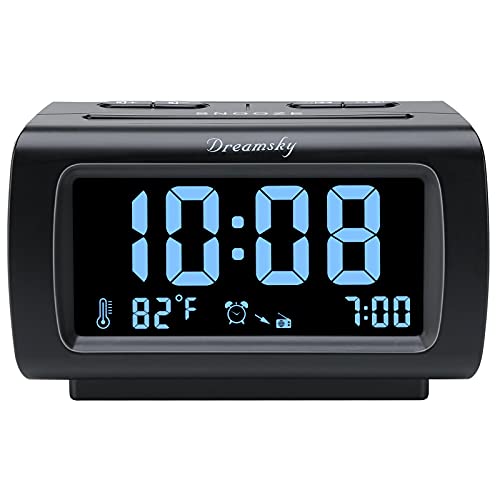
The DreamSky DS206 takes the opposite approach: a large 4-inch LCD with bold blue digits, a temperature readout, and a dimmer wheel that sweeps the brightness continuously from full to fully dark instead of stepping through fixed levels. That wheel is the detail owners tend to praise, because it lets you match the display to a truly dark room.
The radio is FM only, covering the standard FM band, with a sleep timer adjustable from 10 to 120 minutes and an alarm that can wake to the radio or a buzzer at a volume you set independently. The important difference is the backup: the DS206 takes three AAA batteries (not included) and, unlike most of the category, the backup will sound the alarm and keep the correct time during a power outage, so a blackout does not silently cancel your morning. A USB port on the back charges a phone overnight, and the included adapter runs on a long cord that reaches awkward sockets behind the bed.
Choose the DS206 if waking up on time matters more than AM stations, if you read the clock from across the room, or if your area loses power often enough that a settings-only backup feels like a risk. Note the colour variants of this model sit on separate listings, so confirm you are looking at the DS206 listing itself when you order.
3. ANJANK Wooden Digital LED Alarm Clock FM Radio — the charging station (ASIN: B0GC3HBCKR)
ANJANK wraps its clock radio in a wooden cabinet that looks like a small piece of furniture rather than a plastic gadget, then uses the top surface as a Qi wireless charging pad for a phone, with a USB port on the back for a second device. Under the styling it is a full clock radio: FM tuning with room for up to 40 stored stations, a sleep timer running from 10 to 120 minutes, and a choice of nine wake sounds — beeps, nature sounds and a buzzer among them — or your favourite FM station.
The display dims across five levels, the alarm volume builds gradually instead of starting at full blast, and a pair of AAA batteries (not included) keeps the time and settings in memory during an outage, though like the Emerson it needs mains power to run the display and sound the alarm. The compact body, roughly 3.7 by 1.5 by 2.75 inches in the small size, fits narrow nightstands where the DreamSky would crowd the surface.
Choose the ANJANK if the nightstand is short on sockets and surface space, if you want the phone charging on the clock rather than on a separate pad, or if a wood finish simply suits the room better than black plastic. Confirm the size variant on the listing, because this model family is sold in more than one size and colourway on separate listings.
How the three compare
On radio coverage, the Emerson is the only pick here with AM as well as FM, which matters for talk and sports listeners; the DreamSky and ANJANK are FM only. On presets, the ANJANK stores the most stations, the Emerson stores a comfortable number for two listeners, and the DreamSky keeps things simple with manual tuning and a sleep timer.
On outage behaviour, the DreamSky stands apart: it is the pick that still wakes you when the power is out. The Emerson and ANJANK protect your settings and correct themselves afterwards, which is enough for most homes but not the same promise. On display, the DreamSky reads from furthest away and dims the furthest down; the Emerson’s smaller digits suit a bedside glance; the ANJANK splits the difference with a mid-size LED and five dimmer levels.
On charging, the ANJANK is the clear pick, combining a wireless pad and a USB port. The DreamSky has the USB port without the pad. The Emerson keeps the top clear and the price class low, which some buyers prefer: fewer features, fewer things to fail.
Setting up a clock radio well
Placement changes radio reception more than any spec. Keep the clock away from phone chargers and LED lamps, which can add buzz on AM especially, and run the wire antenna out fully rather than coiling it behind the unit. If your favourite station is weak, moving the clock to the window side of the room usually helps more than buying a bigger speaker.
Set the sleep timer and the alarm volume on the first night, not the first groggy morning. If you wake to the radio, pick a station with voices at your wake time; speech cuts through sleep better than music at the same volume. Finally, replace backup batteries once a year and after any long outage — a flat backup cell is the usual reason a clock loses its settings in a short power cut.
A note on AM, FM and everything after
Buyers sometimes ask whether a clock radio is a dead format now that phones stream everything. For the bedside job it is not, for three practical reasons. Broadcast radio needs no account, no subscription and no network connection, and it works during the local emergencies — storms, outages, road closures — when the phone network is the first thing to congest. It also starts instantly at alarm volume, with no app to open and no Bluetooth pairing to fail at 6 a.m. Finally, a clock radio is a single-purpose object: it cannot buzz with messages at 2 a.m., and it will never ask you to update anything. Streaming belongs in the kitchen and the car; the nightstand rewards the simpler tool.
If you do want both worlds, the honest answer is two devices — a clock radio for waking and time, and whatever speaker you already own for streaming — rather than a hybrid that does the bedside basics badly.
The bottom line
For most bedrooms, the Emerson CKS1500 is the straightforward recommendation: automatic time setting, AM and FM with presets, dual alarms and a dimmer, in the smallest body here. If outages or eyesight make the alarm and display the priority, the DreamSky DS206 is the stronger tool. If the nightstand needs to double as the charging point, the ANJANK folds that job into a wooden clock radio that still covers the radio basics properly. Any of the three beats waking to a phone — the clock radio’s real competition — because each one shows the time, plays a station and leaves the notifications in another room.