Key takeaways
- We compare five canister steam cleaners built for tile floors, covering tank size, floor tools, steam heat and reach, so you can pick the right one.
Tile floors hide dirt in plain sight. A kitchen floor can look clean from the doorway and still show a grey film across the grout lines and a sticky patch near the stove once the light hits it at an angle. Mopping moves much of that film around, and a handheld steamer runs dry before you finish one room. The real decision is whether a canister machine can cover a whole tiled area on one fill, with a floor tool wide enough to make steady progress instead of inching along in strips.
This guide is for homeowners with large tiled kitchens, hallways, entryways and bathrooms, for pet owners facing muddy paw prints, and for anyone replacing a mop with steam. Every pick below is a canister-style steam cleaner chosen from its Amazon listing name and specifications, with the floor tool, tank size and runtime weighed against how much tile you actually have to cover.
Quick Picks
As an Amazon Associate we earn from qualifying purchases.
| Product | Best for | Key spec from title |
|---|---|---|
| McCulloch MC1385 | Large tiled areas cleaned in one session | 64 oz tank, up to 120 minutes of steam |
| Dupray Neat | Hot steam and a compact cube body | Steam up to 275°F, 54 oz boiler |
| McCulloch MC1275 | Everyday tile cleaning without a bulky unit | 48 oz tank, up to 45 minutes of steam |
| Vapamore MR-100 Primo | Wide floor head and long sessions | 1.6 L stainless steel boiler, up to 60 minutes of steam |
| Steamfast SF-370 | Lighter canister for smaller tile areas | 1500 watts, 15 accessories included |
How to Choose
Tank size and runtime per fill
A canister steamer is only useful on tile if it keeps producing steam long enough to finish the room. Small tanks mean stopping to cool down, refill and reheat halfway through a hallway, which turns a twenty-minute job into an hour. Look at the runtime per fill rather than the tank size alone, because two machines with similar tanks can run for very different lengths of time. For a single bathroom or a small kitchen, around 45 minutes per fill is enough. For open-plan tile that runs from the kitchen into the living area, aim for an hour or more, or pick a machine that lets you refill without a long wait.
Floor tool width and mop pads
The floor tool decides how fast you cover tile. A narrow head forces you into slow, overlapping passes, while a wide head with a microfiber pad sweeps across large tiles in fewer strokes and picks up loosened dirt instead of pushing it into the grout. Check whether the kit includes more than one mop pad, because a pad soaked with dirty water stops cleaning and starts spreading grime. Washable pads matter too, since you will go through them quickly on a big floor. A swivel joint on the floor head helps around table legs and into corners where tile meets the skirting board.
Steam heat and steam pressure
Heat loosens the sticky residue that mopping leaves behind, and pressure drives steam into the textured surface of the tile and the pores of the grout. Machines that publish a steam temperature let you compare them directly, and hotter steam generally softens dried-on spills faster. Pressure matters just as much, because low-pressure steam can feel like a warm mist that wets the floor without lifting anything. Some makers publish neither figure, so treat the tank size, wattage and runtime as your guide instead. Whatever you choose, remember that very hot steam is not suitable for every surface, so check that your tile and grout are sealed before you start.
Hose reach, cord length and unit weight
A canister steamer trails behind you on its hose and cord, so reach decides how much of a room you can clean before hunting for another socket. A short hose means dragging the canister around corners and over thresholds, which gets tiring on a large floor. A long power cord and a hose of six feet or more let the unit sit in the middle of a room while you work outward. Weight matters too, especially on stairs or when you carry the machine between rooms. A lighter unit with wheels is easier to move, while a heavier one with a bigger boiler usually runs longer but needs more effort to reposition.
The 5 Best Options
McCulloch MC1385 Deluxe Canister Steam Cleaner

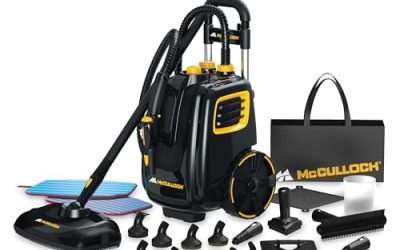
The MC1385 is the workhorse of this list, built around a large refillable tank that keeps steam going for up to two hours on one fill. That kind of runtime suits open-plan tile that runs through several rooms, because you can start in the kitchen and keep going into the hallway without stopping to cool down and refill. The kit includes a mop head for floors, extension wands, brushes and a squeegee, so the same machine handles the flat tile and the edges where dirt collects. It is a big unit, so it stays parked while you work the wand across the floor.
Specs
- Water tank capacity: 64 oz
- Heating power: 1500 watts
- Continuous steam: up to 120 minutes
- Heat-up time: about 12 minutes
- Accessories included: 23
- Hose length: 7 ft
Best for: Large tiled areas cleaned in a single session without refilling.
Watch out for: The unit is heavy and bulky, so check that you have storage space and a clear path to move it between rooms.
Dupray Neat Steam Cleaner

The Dupray Neat packs its boiler into a compact cube that sits neatly in a corner and rolls out when needed. Its steam reaches up to 275°F, which is hotter than most machines in this list, and that extra heat helps soften dried spills and sticky residue on tile without detergent. The 54 oz stainless steel boiler gives up to 50 minutes of steam per fill, enough for a kitchen and a bathroom back to back. The kit includes a floor tool, a triangle bonnet for corners, brushes and microfiber pads, so you can switch from open floor to edges without changing machines.
Specs
- Boiler capacity: 54 oz (1600 ml)
- Heating power: 1500 watts
- Steam temperature: up to 275°F
- Steam pressure: up to 50 PSI
- Continuous steam: up to 50 minutes
- Accessories included: 17
- Weight: 9 lbs
Best for: Homeowners who want the hottest steam in a compact canister that stores easily.
Watch out for: The boiler must cool before refilling, so plan your cleaning order to avoid a mid-session wait.
McCulloch MC1275 Heavy-Duty Steam Cleaner

The MC1275 is the smaller sibling of the MC1385, with the same canister shape and a shorter runtime that fits everyday tile cleaning. Its 48 oz tank delivers up to 45 minutes of steam, which covers a kitchen, a bathroom and a hallway in most homes. The kit includes a mop head, extension wands, brushes and a squeegee, and the extra-long power cord means fewer socket changes as you move between rooms. It heats up in about eight minutes, so it is ready quickly for a spill or a regular weekly clean. For tile floors that get cleaned often, this is the straightforward middle ground.
Specs
- Water tank capacity: 48 oz
- Heating power: 1500 watts
- Continuous steam: up to 45 minutes
- Heat-up time: about 8 minutes
- Accessories included: 18
- Power cord: extra-long
Best for: Regular weekly cleaning of kitchens, bathrooms and hallways with tile.
Watch out for: The 45-minute runtime can run short on very large tiled areas, so measure your floor space before deciding.
Vapamore MR-100 Primo Steam Cleaner

The MR-100 Primo is built around a stainless steel boiler, which sets it apart from canister steamers with aluminium boilers and suits owners who want a machine that lasts. Its wide floor head covers more tile with each pass, and the 1.6 L tank delivers up to 60 minutes of continuous steam. The kit is generous, with 20 accessories including a carpet slider, a squeegee, brushes and a triangle corner tool, so the machine moves from open floor to edges and upholstery without extra purchases. An 18 ft power cord and a 6 ft hose give you room to work around a large tiled space.
Specs
- Boiler capacity: 1.6 L (54 oz)
- Heating power: 1500 watts
- Steam temperature: up to 220°F
- Continuous steam: up to 60 minutes
- Heat-up time: about 5 minutes
- Accessories included: 20
- Power cord: 18 ft
- Steam hose: 6 ft
Best for: Large tile floors where a wide floor head and a durable stainless steel boiler matter.
Watch out for: The unit weighs around 20 lbs unfilled, so carrying it up stairs takes effort.
Steamfast SF-370 Canister Steam Cleaner

The SF-370 is the lightest canister in this list, a white unit that trades tank size for easy handling on smaller tile areas. It heats up in about eight minutes and runs for around 45 minutes per fill, which suits a kitchen, a bathroom or an entryway cleaned in one pass. The kit includes 15 accessories, with a floor mop head, extension tubes, brushes and a squeegee, and the long power cord and hose let you reach across a room without moving the unit constantly. It is a good fit when you want canister steam without the weight and bulk of the larger machines.
Specs
- Heating power: 1500 watts
- Continuous steam: up to 45 minutes
- Heat-up time: about 8 minutes
- Accessories included: 15
- Power cord: 15 ft
- Steam hose: 6.5 ft
Best for: Smaller tile areas and anyone who wants a lighter canister that is easy to carry and store.
Watch out for: The smaller tank means refilling on bigger jobs, so it suits one or two rooms at a time rather than a whole tiled floor.
Which One Fits Your Situation
Large open-plan tile areas
If your tile runs from the kitchen through the dining area and into the hallway, runtime is the deciding factor. Pick the McCulloch MC1385, whose 64 oz tank and two-hour runtime let you clean the whole stretch without stopping to refill. The Vapamore MR-100 Primo is the backup choice here, with an hour of steam and a wide floor head that covers ground quickly.
Small kitchens and bathrooms with tile
For one or two tiled rooms, a smaller canister is easier to store and quicker to set up. The McCulloch MC1275 covers a kitchen and a bathroom on one fill, and the Steamfast SF-370 is lighter still if you carry the unit between floors. Either one handles daily spills and weekly deep cleans without the bulk of a large machine.
Homes with pets and muddy paws
Pet owners need hot steam and fresh mop pads, because muddy prints and tracked-in dirt build up fast on tile. The Dupray Neat is the pick here, with steam up to 275°F and a set of microfiber pads for the floor tool. Keep a spare pad on hand so you can swap mid-clean instead of spreading dirty water across the floor.
A first canister steamer for occasional use
If you are switching from a mop and want to try steam without committing to a heavy machine, start with the Steamfast SF-370. It is the lightest canister here, heats up in about eight minutes, and includes the floor tool and brushes you need for tile. If you later find yourself steaming every week, the McCulloch MC1275 is the natural step up.
Common Mistakes
- Using a steam cleaner on unsealed tile or grout, which lets moisture soak in instead of lifting dirt off the surface.
- Cleaning with a dirty mop pad, which spreads grime across the floor instead of picking it up.
- Skipping the vacuum or sweep first, so loose grit gets pushed around and can scratch the tile.
- Holding the floor tool still in one spot, which leaves excess moisture and streaks on the tile.
- Refilling a hot pressurised boiler before it has cooled, which can cause burns or damage the machine.
Frequently Asked Questions
Can a canister steam cleaner damage tile floors?
Sealed ceramic and porcelain tile handle steam well, because the glaze protects the surface from moisture and heat. Unsealed natural stone, cracked tiles and crumbling grout are a different story, since steam can drive water into pores and gaps. Check that your tile and grout are sealed, and keep the floor tool moving instead of holding it in one spot.
Do I need detergent with a steam cleaner?
No, canister steam cleaners are designed to clean with water alone, and the heat does the work of loosening dirt and grease. Adding detergent can leave a sticky residue on tile and may damage the boiler or clog the hose. If a stain resists steam, loosen it with a brush attachment and wipe it away rather than adding chemicals to the tank.
How often should I change the mop pad?
Change the pad as soon as it looks dirty or feels heavy with water, which on a large tile floor can be halfway through the job. A soaked pad stops absorbing and starts spreading dirty water back onto the tile. Keep at least one spare washable pad ready, and wash pads after every use so they are clean for the next session.
Can I use tap water in a canister steam cleaner?
Tap water works in most areas, but hard water leaves mineral deposits inside the boiler over time, which shortens the life of the machine. If your water is hard, use distilled water or a mix of tap and distilled water, and flush the boiler regularly as the manual describes. Never add vinegar or descaling chemicals to the tank unless the maker says so.