Our Short List of 3
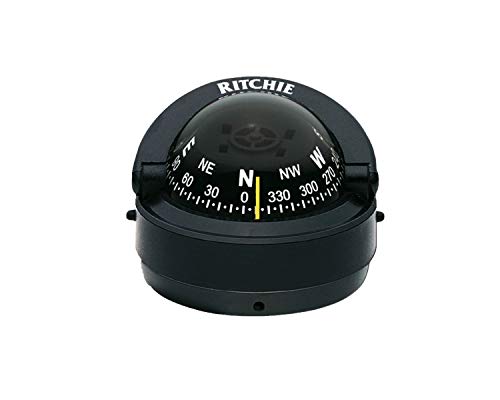
- Best for: Flat dash tops on center consoles and runabouts
- Mounting type: Surface mount
- Dial: 2-3/4 inch direct-read
- Color: Black
- Dimensions: 4 x 5 x 5 inches

- Best for: Angled or vertical helm surfaces that need a tilting mount
- Mounting type: Bracket mount
- Dial: 2.75-inch direct-read
- Color: Black
- Weight: 0.85 lb

- Best for: A factory-fitted look on light-colored consoles and sailboat panels
- Mounting type: Flush mount
- Dial: 2-3/4 inch Direct-Read, white
- Housing color: White
- Movement: Hardened steel pivot, sapphire jewel
All 4 Picks at a Glance
| Product | Specs | Action |
|---|---|---|
| Ritchie Explorer S-53 |
| Check price on Amazon |
| Ritchie Explorer B-51 |
| Check price on Amazon |
| Ritchie Explorer F-50W |
| Check price on Amazon |
 RitchieSport X-10B-M |
| Check price on Amazon |
Key takeaways
- Compare four Ritchie small boat compasses by mount, dial size and night lighting, with fit notes for center consoles, skiffs and small sailboats.
A magnetic compass is the one helm instrument that keeps working when the plotter screen washes out in sun glare, the battery bank sags, or spray knocks out a touchscreen. On a small boat the real decision is not whether to carry one, but which mounting style fits the helm you actually have: a flat dash top, an angled panel you cannot cut, or a bulkhead with room behind it. Dial size matters just as much, because a card that is easy to read from the helm seat at noon can turn into a guess at dusk.
The four compasses below suit skippers of center consoles, runabouts, small sailboats and fishing skiffs who want a fixed heading reference that needs no power beyond a night light wire. Each one is a Ritchie magnetic steering compass picked from its listing details: mount type, dial size, compensators and night lighting, so the differences that decide a purchase are the ones printed on the box.
Quick Picks
As an Amazon Associate we earn from qualifying purchases.
| Product | Best for | Key spec from title |
|---|---|---|
| Ritchie Explorer S-53 | Flat dash tops, no-cut installs | Surface mount, 2-3/4 inch dial |
| Ritchie Explorer B-51 | Angled or vertical helm surfaces | Bracket mount, 2.75-inch dial |
| Ritchie Explorer F-50W | Built-in, factory-fitted look | Flush mount, white 2-3/4 inch dial |
| RitchieSport X-10B-M | Tight helms on the smallest boats | Bracket mount, 2-inch dial |
How to Choose
Mounting Style Comes First
Begin with the surface the compass will live on, because the mount decides the whole install. A surface mount sits on top of a flat dash or coaming and needs no cutout, which suits trailer boats and consoles with no depth behind the panel. A bracket mount hangs from a tilting bracket, so it works on angled, vertical or even overhead spots and can be aimed at the helm seat. A flush mount drops into a hole cut in the panel and leaves only the bezel and dial showing, the cleanest finish but the least forgiving if you change your mind later.
Dial Size and Reading Distance
Most small-boat compasses use a direct-read dial, read at the lubber line on the near side of the card, and the common sizes run from 2 inches to 2-3/4 inches. A 2-3/4 inch card gives bigger numerals and wider degree marks, which helps when the helm seat sits a step away from the dash or the boat is moving in chop. A 2 inch dial keeps the housing compact for tight skiff helms, but you read it from closer range and small heading changes are harder to spot at a glance. Match dial size to your normal eye-to-dash distance, not to the space left over.
Compensators and Deviation
Every boat carries its own magnetic clutter: engine blocks, steel fasteners, speakers, wiring runs and nearby electronics all bend the field around the compass and pull readings off true, an error called deviation. Built-in compensators are small adjustable magnets inside the housing that let you cancel much of that error during a short swinging routine after install. A compass without compensators can still serve on a fiberglass boat with a clean helm area, but on a metal-heavy console you want the adjustable kind, and you want the compass placed as far from speakers and steel as the layout allows.
Night Lighting and Build
Night runs and dawn departures are where a compass earns its place, so check how the dial is lit. The common setup is a 12 volt internal light, often green, wired to the same circuit as the dash lights; it draws little current but does need a wire run during install. Housing build matters too: a high-temperature composite body tolerates a dash that bakes in summer sun, a sapphire jewel movement on a hardened steel pivot keeps the card moving freely, and a maker who sells service parts can repair the unit instead of leaving you to replace it after a knock.
The 4 Best Options
Ritchie Explorer S-53
- Best for: Flat dash tops on center consoles and runabouts
- Mounting type: Surface mount
- Dial: 2-3/4 inch direct-read
- Color: Black
- Dimensions: 4 x 5 x 5 inches
Flat dash tops on center consoles and runabouts
The dial and internals match the bracket and flush Explorers, so the choice is purely the mount; confirm the black S-53 variant on the listing page, since gray (S-53G) and white (S-53W) versions share the family.
The Explorer S-53 is the default pick when your console has a flat top and you want the compass fitted in minutes rather than cut into the panel. Its low base screws or pads onto the dash, the housing lifts off the base with push buttons for storage or service, and the 2-3/4 inch direct-read dial is large enough to follow from a leaning post. Built-in compensators and 12 volt green night lighting come standard on this Explorer line, so it covers the small center console, runabout and skiff helm without asking for dash surgery.
Ritchie Explorer B-51
- Best for: Angled or vertical helm surfaces that need a tilting mount
- Mounting type: Bracket mount
- Dial: 2.75-inch direct-read
- Color: Black
- Weight: 0.85 lb
Angled or vertical helm surfaces that need a tilting mount
The bracket needs two bolt holes, and a surface that is not square to the centerline may need a fairing block under it; if you have a flat dash top, the S-53 sits lower and simpler.
Choose the Explorer B-51 when the helm gives you no flat, level spot: the bracket bolts to an angled panel, a vertical face or an overhead and tilts the compass until the dial squares up to your eyes. That makes it the flexible answer for older runabouts, dual consoles and sailboat cockpits where the only free surface leans. It carries the same 2.75-inch direct-read dial as the surface mount Explorer, in a black housing, so readability stays familiar while the mounting problem disappears. Owners who remove gear for winter storage also like that a bracket unit unbolts cleanly.
Ritchie Explorer F-50W
- Best for: A factory-fitted look on light-colored consoles and sailboat panels
- Mounting type: Flush mount
- Dial: 2-3/4 inch Direct-Read, white
- Housing color: White
- Movement: Hardened steel pivot, sapphire jewel
A factory-fitted look on light-colored consoles and sailboat panels
It needs a hole cut in the panel and clear depth behind it, so measure the space and check for wiring runs before you commit; once cut, switching to another mount style leaves a hole to fill.
The Explorer F-50W suits the owner who wants the compass to look factory fitted: it drops into a cut hole in the console or bulkhead and leaves a clean white bezel around a white 2-3/4 inch direct-read dial that stays easy to read in bright sun. The listing describes a hardened steel pivot with a sapphire jewel movement, high temperature composite construction and internal green NiteVu illumination, plus a fully repairable build backed by a five year warranty from the maker. Pick it when the panel has depth behind it and the helm layout is settled.
RitchieSport X-10B-M
- Best for: Tight helms on jon boats, skiffs and small sailboats
- Mounting type: Bracket mount, reversible
- Dial: 2-inch direct-read, black
- Housing: Black
- Night lighting: Internal green
Tight helms on jon boats, skiffs and small sailboats
The 2-inch card is the smallest here; from a helm seat set well back, or in rough water, the bigger 2-3/4 inch dials are easier to follow.
The RitchieSport X-10B-M is the compact answer for the smallest helms: a 2-inch direct-read dial in a black housing on a reversible bracket that swings through more than 300 degrees of mounting range, from overhead to horizontal. At 0.2 pounds it adds almost nothing to a jon boat, skiff or small sailboat helm, yet the listing still includes built-in compensators and internal green night lighting, so the small card can be corrected for deviation like its bigger Explorer cousins. It is the pick when space, not dial size, is the hard limit.
Which One Fits Your Situation
A Flat Dash Top on a Center Console
If your console top is flat and clear, the Explorer S-53 is the straightforward fit: it mounts on the surface with no cutout, keeps a low profile that stays out of the sightline, and its 2-3/4 inch dial reads well from a leaning post. It is also the easiest of the four to remove later, since the housing lifts off its base.
An Angled Panel or Awkward Helm
When the only free surface leans, is vertical, or sits overhead, a bracket mount solves the geometry. The Explorer B-51 tilts its 2.75-inch dial to face you and suits most small powerboats, while the smaller RitchieSport X-10B-M fits the same trick into tighter corners. Either way, leave room to swing the bracket while you aim it before the final tightening.
A Clean, Built-In Helm Finish
If the boat is a keeper and the panel has depth behind it, the flush mount F-50W gives the tidiest result: only the white bezel and dial show, nothing snags a line or a sleeve, and the white card stays readable in hard sun. Budget the install time for measuring and cutting the hole, and confirm the space behind the panel before you cut.
A Small Skiff, Jon Boat or Dinghy Helm
On the smallest boats the compass competes with a fish finder, a cup holder and your knees. The X-10B-M asks for the least room, weighs 0.2 pounds, and its bracket can share an odd corner or rail-side face. Accept the trade: the 2-inch dial wants a helm seat close behind it, so mount it where your eyes naturally rest.
Common Mistakes
- Bolting the compass down beside a speaker, a VHF radio or a steel grab rail, then blaming the compass for readings that wander every time the gear is switched on.
- Skipping the compensation routine after install. Built-in compensators only correct deviation once they have been adjusted on known headings, in the order the maker prints.
- Cutting the hole for a flush mount before checking the depth and wiring runs behind the panel, then finding the housing has nowhere to sit.
- Picking the smallest 2-inch dial for a helm seat set well back from the dash, where its card is hard to follow in chop or glare.
- Using ordinary steel screws to mount the compass. Steel fasteners near the card add their own deviation; use the non-magnetic hardware the maker supplies or specifies.
Frequently Asked Questions
Does a small boat still need a magnetic compass with GPS on board?
Yes, as a backup and a steering reference. A chartplotter shows course over ground, which lags and swings at low speed and vanishes with a flat battery or a failed screen. A magnetic compass shows the heading the bow is pointing right now, draws no power for the card itself, and keeps working through electrical trouble, which is why many skippers steer by it and glance at the plotter.
How far should the compass sit from speakers and electronics?
As far as the helm layout allows, and farther from speakers than from anything else, because speaker magnets are strong for their size. Hold the compass in its planned spot with the engine and electronics running, watch whether the card shifts as gear is switched on, and only then drill. Built-in compensators can cancel a steady leftover error, not a field that changes every time a device wakes up.
Can I install a flush mount compass myself?
Yes, with care: the job is measuring twice, cutting one clean hole, seating the housing and wiring the night light. The unforgiving part is the cut, because a hole in the wrong place or of the wrong size cannot be undone, and the space behind the panel must fit the housing depth. If the panel is thin, curved or crowded behind, a surface or bracket mount is the safer install.
Why does my compass read differently near the dock than offshore?
Readings shift when the magnetic surroundings change. Steel pilings, a boat lift and shore power gear near a dock add their own fields, and on board a phone or a steel bottle left beside the helm can pull the card. A constant error on every heading is deviation the compensators can swing out; an error that changes with nearby objects means the compass or the clutter has to move.